Problems
Let \(X\) be a finite set, and let \(\mathcal{P}X\) be the power set of \(X\) - that is, the set of subsets of \(X\). For subsets \(A\) and \(B\) of \(X\), define \(A*B\) as the symmetric difference of \(A\) and \(B\) - that is, those elements that are in either \(A\) or \(B\), but not both. In formal set theory notation, this is \(A*B=(A\cup B)\backslash(A\cap B)\).
Prove that \((\mathcal{P}X,*)\) forms a group.
The lengths of three sides of a right-angled triangle are all integers.
Show that one of them is divisible by \(5\).
How many integers are there \(n>1\) such that \(a^{25}-a\) is divisible by \(n\) for every integer \(a\).
Let \(p\) be a prime number, \(a\) be an integer, not divisible by \(p\). Prove that \(a^p-a\) is divisible by \(p\).
Let \(n\) be an integer. Denote by \(\phi(n)\) the number of integers from \(1\) to \(n-1\) coprime to \(n\). Find \(\phi(n)\) in the following cases:
\(n\) is a prime number.
\(n = p^k\) for a prime \(p\).
\(n=pq\) for two different primes \(p\) and \(q\).
Let \(n\) be an integer and let \(a\) be an integer coprime to \(n\). Prove that \(a^{\phi(n)-1}-1\) is divisible by \(n\).
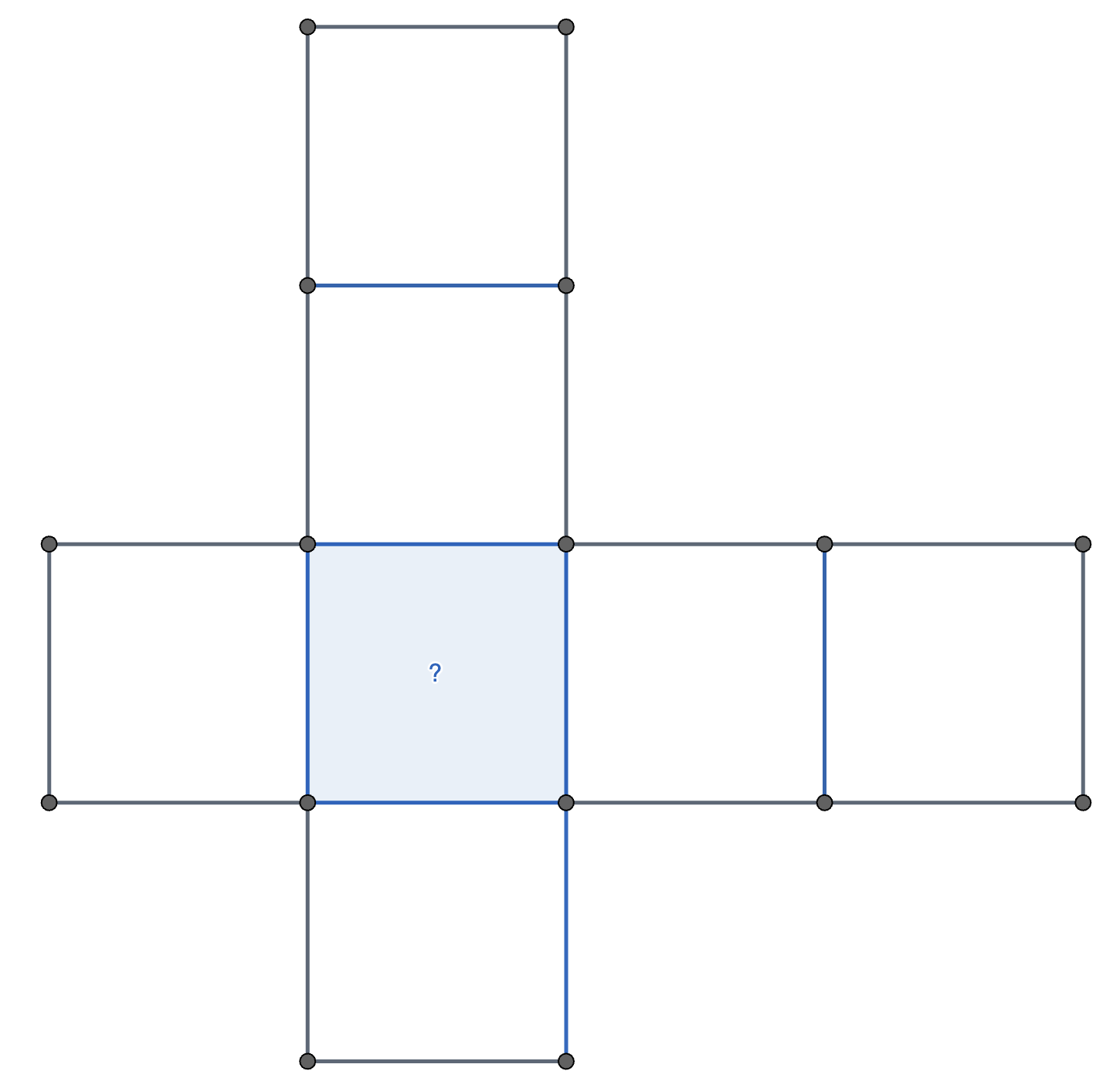
In the diagram below, I wish to write the numbers \(6, 11, 19, 23, 25, 27\) and \(29\) in the squares, but I want the sum of the numbers in the horizontal row to equal the sum of the numbers in the vertical column. What number should I put in the blue square with the question mark?
You have a row of coins and you can perform these three operations as many times as you like:
Remove three adjacent heads
Remove two adjacent tails
If there’s a tail followed by a heads, then turn the tail over and put a new tail after both heads
You apply these operations until you can’t make any more moves. Show that you will always get the same configuration at the end, no matter the order.
Let \(a\) be a positive integer, and let \(p\) be a prime number. Prove that \(a^p - a\) is a multiple of \(p\).
We ‘typically’ use the formula \(\frac{1}{2}bh\) for the area of a triangle, where \(b\) is the length of the base, and \(h\) is the perpendicular height. Here’s another one, called Heron’s formula.
Call the sides of the triangle \(a\), \(b\) and \(c\). The perimeter is \(a+b+c\). We call half of this the semiperimeter, \(s=\frac{a+b+c}{2}\). Then the area of this triangle is \[\sqrt{s(s-a)(s-b)(s-c)}.\] Prove this formula is correct.