Problems
By checking which of the following numbers are divisible by \(11\): \[121,\,143,\,286,\,235,\,473,\,798,\,693,\,576\] can you find and prove a condition that is enough to guarantee a number is divisible by \(11\)?
You meet an alien, who you learn is thinking of a positive integer \(n\). They ask the following three questions.
“Am I the kind who could ask whether \(n\) is divisible by no primes other than \(2\) or \(3\)?"
“Am I the kind who could ask whether the sum of the divisors of \(n\) (including \(1\) and \(n\) themselves) is at least twice \(n\)?"
“Is \(n\) divisible by 3?"
Is this alien a Crick or a Goop?
Find the mistake in the sequence of equalities: \(-1=(-1)^{\frac{2}{2}}=((-1)^2)^{\frac{1}{2}}=1^{\frac{1}{2}}=1\).
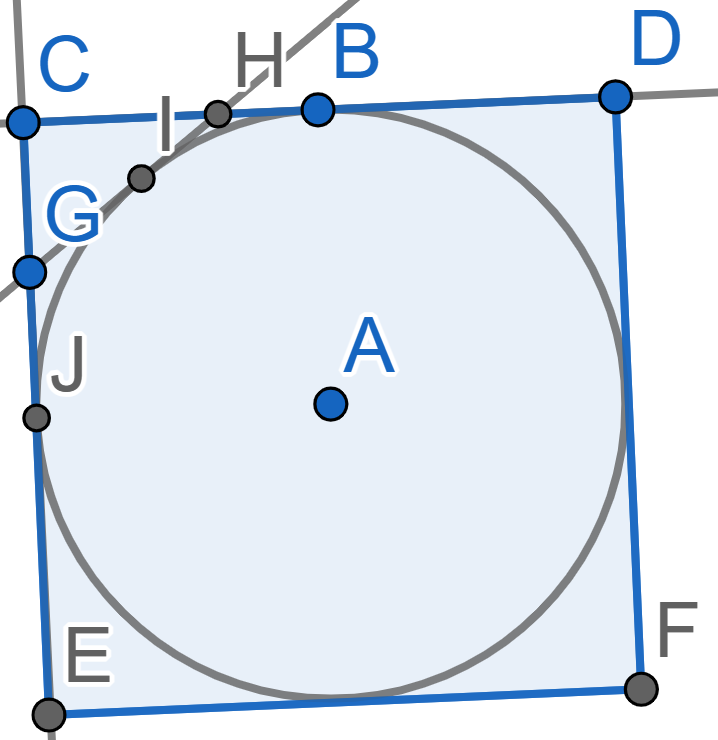
A circle with center \(A\) is inscribed into a square \(CDFE\). A line \(GH\) intersects the sides \(CD\) and \(CE\) of the square and is tangent to the circle at the point \(I\). Find the perimeter of the triangle \(CHG\) (the sum of lengths of all the sides) if the side of the square is \(10\)cm.
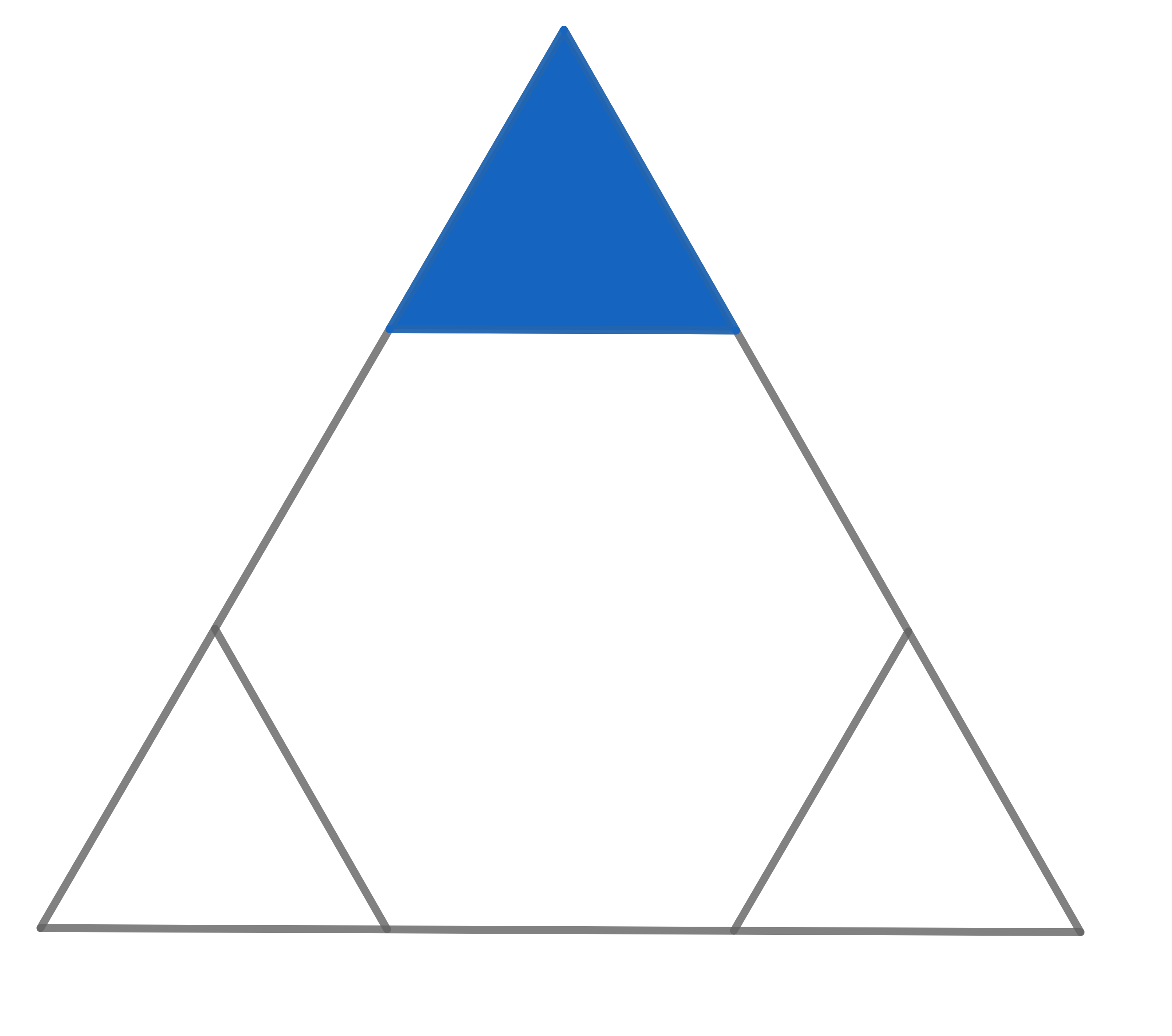
The triangle visible in the picture is equilateral. The hexagon inside is a regular hexagon. If the area of the whole big triangle is \(18\), find the area of the small blue triangle.
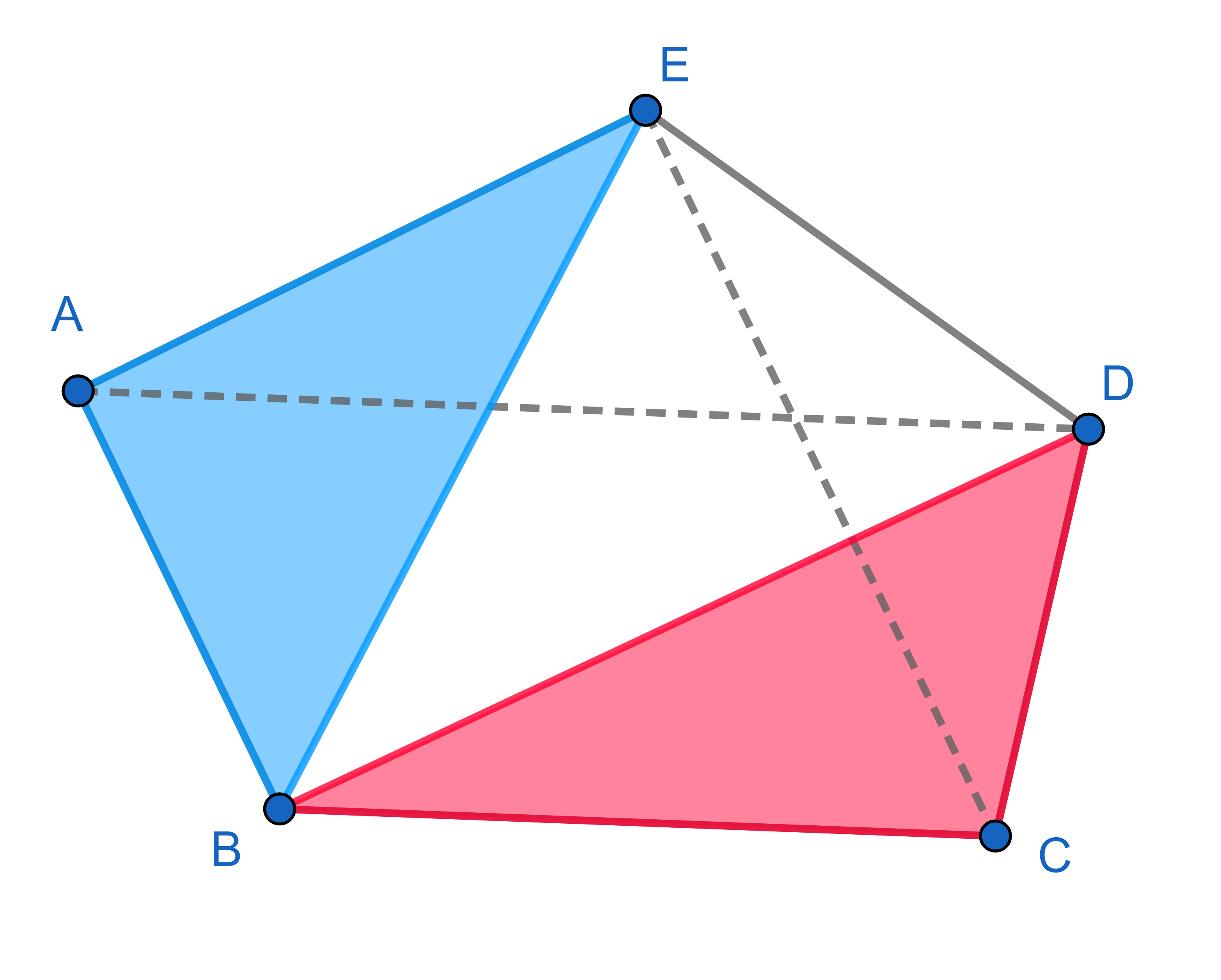
In a pentagon \(ABCDE\), diagonal \(AD\) is parallel to the side \(BC\) and the diagonal \(CE\) is parallel to the side \(AB\). Show that the areas of the triangles \(\triangle ABE\) and \(\triangle BCD\) are the same.
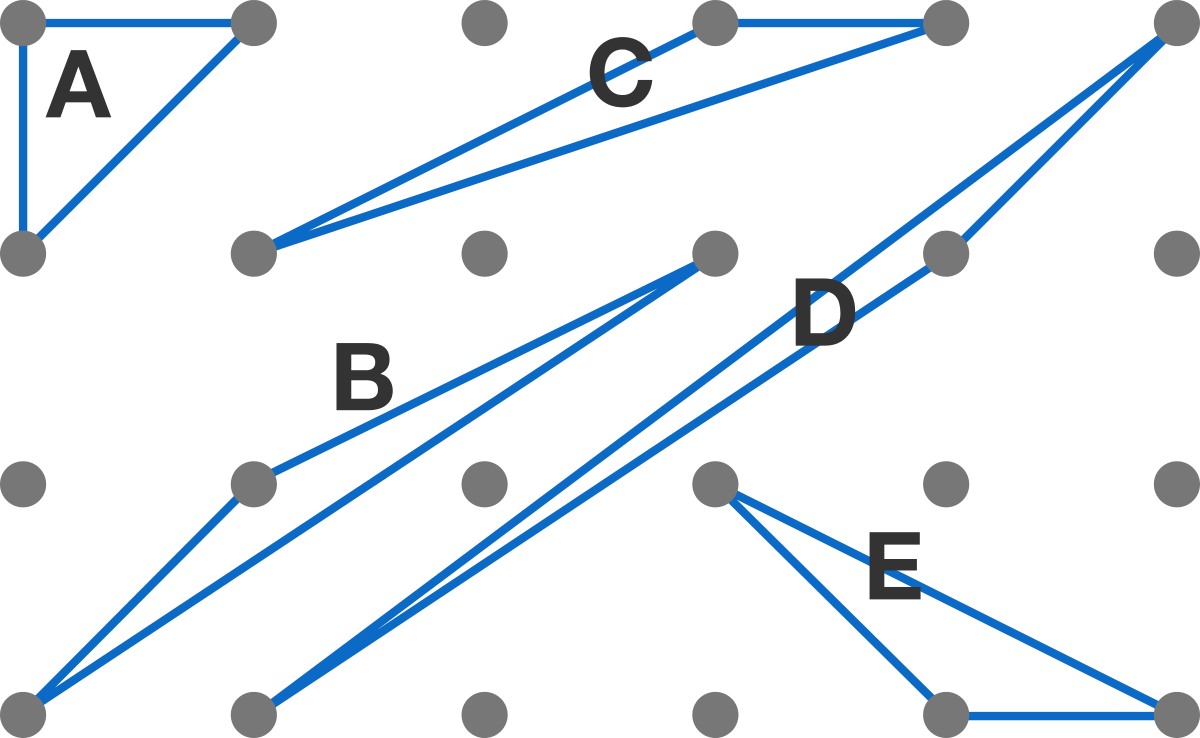
Which triangle has the largest area? The dots form a regular grid.
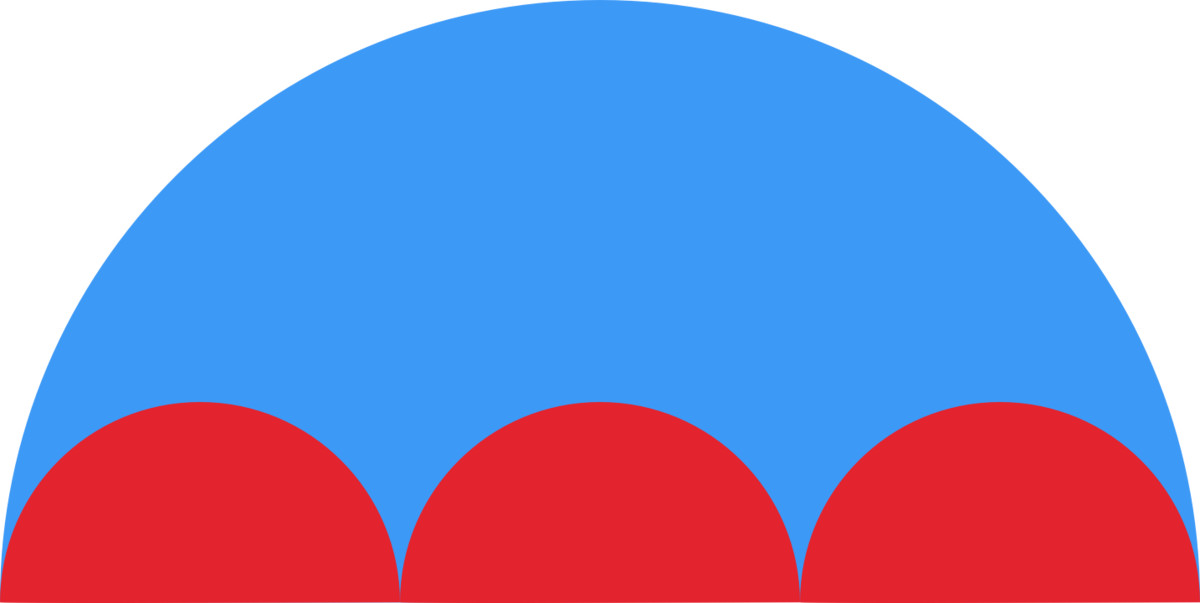
What is the ratio between the red and blue area? All shapes are semicircles and the red ones have equal radii.
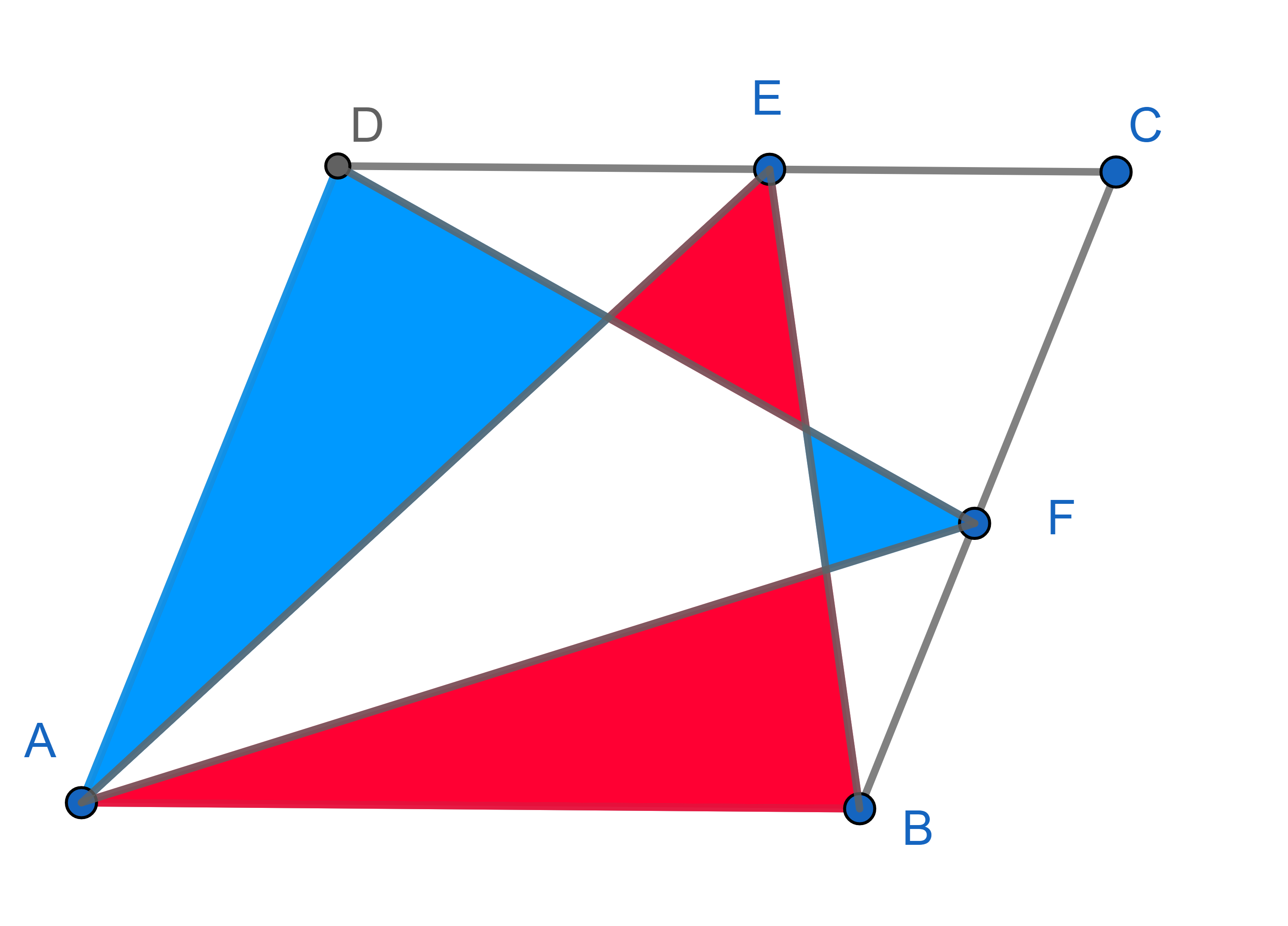
In a parallelogram \(ABCD\), point \(E\) belongs to the side \(CD\) and point \(F\) belongs to the side \(BC\). Show that the total red area is the same as the total blue area: