Problems
We write all \(26\) different letters of the English alphabet in a line, using each letter exactly once.
How many such arrangements do not contain any of the strings
fish, rat, or bird?
For a trapezium \(ABCD\), let \(E\) be the point of intersection of the sides \(AB\) and \(CD\), and let the point \(G\) be the point of intersection of the diagonals of the trapezium. Finally, let \(F\) amd \(H\) be the midpoints of the sides \(BC\) and \(AD\) respectively.
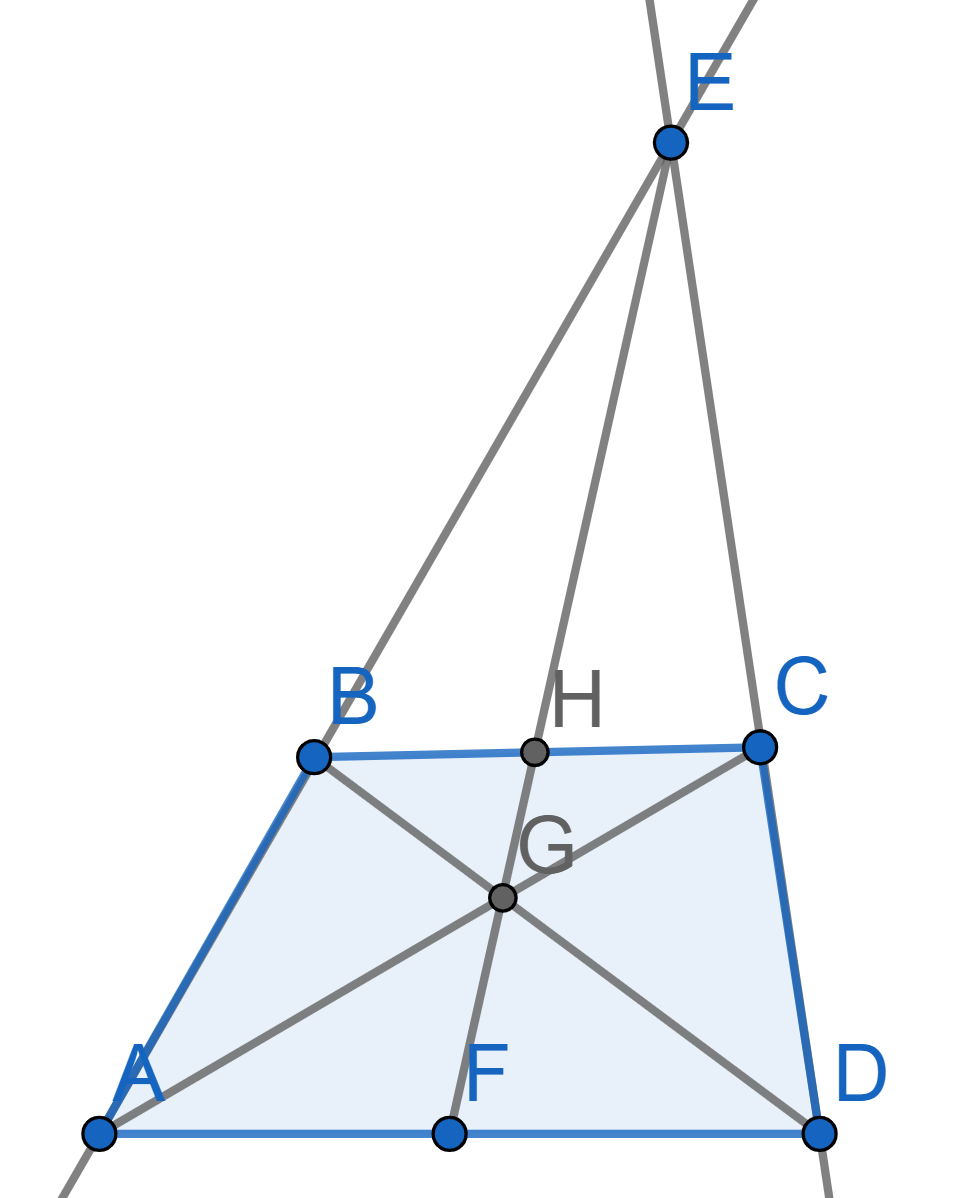
Prove that the points \(E,F,G,H\) lie on one line.
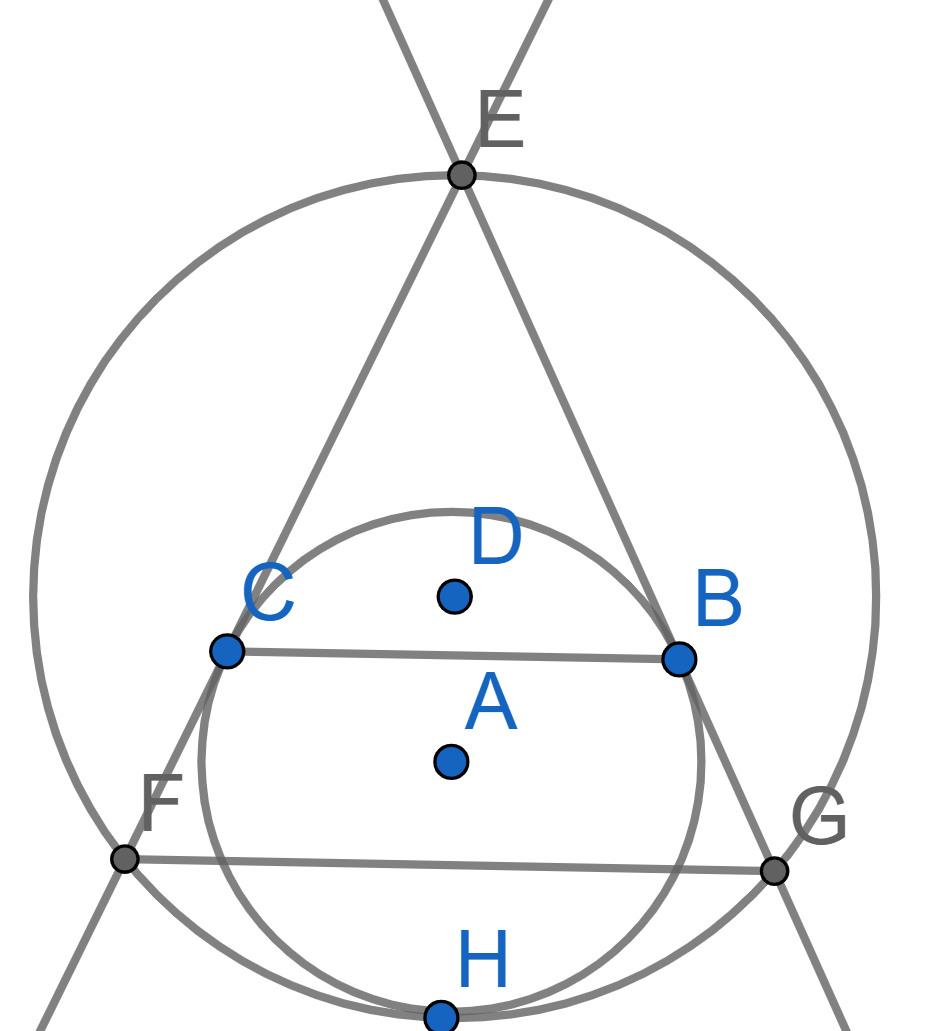
The triangle \(EFG\) is isosceles with \(EF=EG\). A circle with center \(A\) is tangent to the sides \(EF\) and \(EG\) at the points \(C\) and \(B\) respectively. It is also tangent to the circle circumscribed around the triangle \(EFG\) at the point \(H\). Prove that the midpoint of the segment \(BC\) is the center of the circle inscribed into the triangle \(EFG\).
Prove that under a homothety transformation, a polygon is transformed into a similar polygon.
Hint: to show this, why is it enough for you to show that homothety preserves angles and ratios?
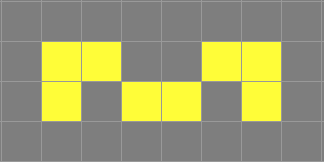
In the Game of Life, each cell in a grid is either alive or dead (in the diagram, yellow cells are alive). At each step, a live cell stays alive only if it has \(2\) or \(3\) live neighbours, otherwise it dies; a dead cell becomes alive only if it has exactly \(3\) live neighbours. A still-life is a pattern that does not change after any number of steps. Show that the following pattern cannot be turned into a still-life by only changing dead cells into alive cells.
Is it possible to arrange \(10\) numbers in a row such that:
The sum of any \(4\) consecutive numbers is positive.
The sum of any \(5\) consecutive numbers is positive.
The sum of any \(7\) consecutive numbers is negative?
In how many different ways can you place \(12\) chips in the squares of a \(4\times 4\) board so that
there is at most one chip in each square, and
every row and every column contains exactly three chips?
On a TV screen the number \(1\) appears. Every minute that passes by, the number that is currently on the screen increases by the sum of its digits. For example: if at some point the number \(12\) appears on the screen, the next number will be \(12+(1+2)=15.\) Will the number \(123456\) ever appear on the screen?
Seven vertices of a cube are labelled with the number \(0\), and the remaining vertex is labelled with \(1\). You are allowed to repeat the following move: choose an edge of the cube and increase by \(1\) the numbers at both ends of that edge.
Is it possible to reach eight numbers that are all divisible by three?
Each number on the number line (not only whole numbers!) is painted black \((B)\) or white \((W)\). Is it always possible, regardless of how the number line is painted, to find a line segment such that both its endpoints and its middle point are painted with the same colour?