Problems
Cut a square into three parts and then use these three pieces to form a triangle such that:
All its angles are acute (i.e: less than \(90^\circ\)).
All its sides are of different lengths.
Jamie has a bag full of cards, where each card has a whole number written on it. How many cards must Jamie take from the bag to be certain that, among the cards chosen, there are at least two numbers whose average is also a whole number? Recall that to calculate the average of two numbers, we add them together and then divide by two.
Long before meeting Snow White, the seven dwarves lived in seven different mines. There is an underground tunnel connecting any two mines. All tunnels were separate, so you could not start in one tunnel and somehow end up in another. Is it possible to walk through every tunnel exactly once without retracing your path?
The Pythagorean Theorem is one of the most important facts about geometry. It says that if we have a right-angled triangle (i.e: it has an angle of \(90^\circ\)), whose longest side measures \(C\), and its other two other sides measure \(A\) and \(B\):
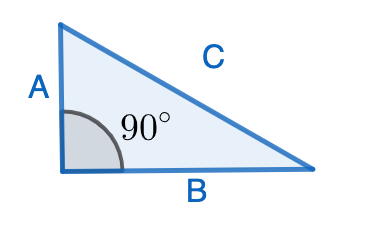
then \(A^2+B^2=C^2\). There are many proofs of this fact, and some involve dissections! Let’s have a look at the following two ways to dissect the same square:
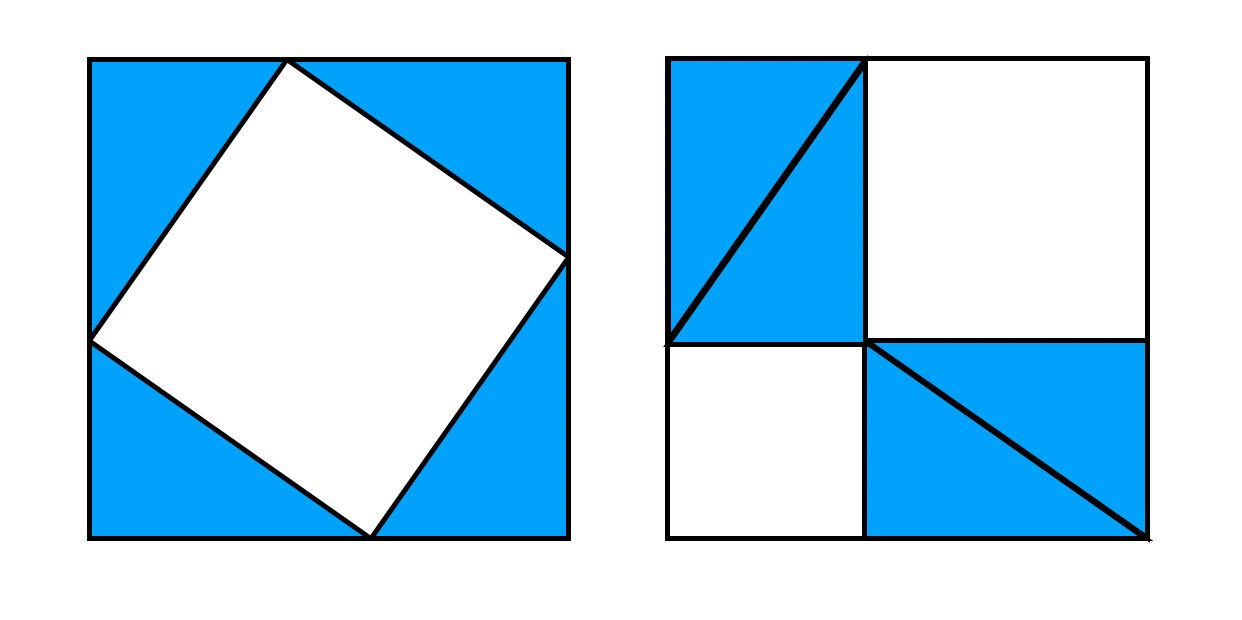
Can you explain how these dissections prove the Pythagorean Theorem?
Seven Smurfs live in seven mushroom houses. There is a tunnel between every pair of houses, so from any house you can walk to any other house. One of the Smurfs, Clumsy, starts walking from his house, but he must not use the same tunnel more than once. He keeps walking until he reaches a house where all the tunnels have already been used. Where will Clumsy’s journey end?
Imagine a \(2\times 2\) “Lights Out" board. If every light is off at the start, how can we turn on just one of the squares? Can you notice something about the order in which we press squares?
Suppose we have a \(2\times 2\) board where all the lights start being turned off, how can we turn on the top two lights?
A \(2\times 2\) "Lights Out" board starts with all the light being turned off. How can you turn on the top-left and bottom-right squares at the same time?
Now let’s imagine a \(3\times 3\) board, how can you turn on just the middle light?
A very important tool in maths is to use symmetries to make problems easier. For today, define a symmetry of a shape as a movement that leaves the shape looking exactly the same as initially. For example, rotating a square by \(90^\circ\) (spinning it by a quarter turn) is a symmetry. Imagine you are playing lights out on a board that has no quiet plans. Explain why if a light pattern has a certain symmetry, then its corresponding plan will also have the same symmetry.