Problems
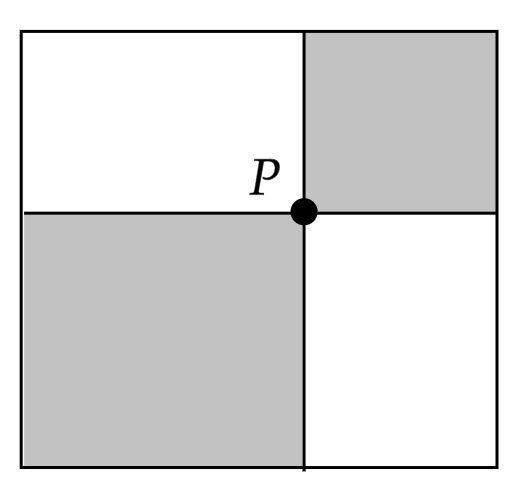
We have a square of side-length \(10\). A point \(P\) is drawn inside the square somewhere along the diagonal, and then the square is split and shaded as in the following diagram. Where should \(P\) be placed so that the shaded area is as smallest as possible? What will this shaded area be?
Let \(ABCD\) be a convex quadrilateral (convex means that all its internal angles are less than \(180^\circ\), i.e: it doesnt “bulge inwards"). Let \(E\) be the point of intersection of the diagonals. We are told that the triangles \(\triangle AED\) and \(\triangle BEC\) have equal areas. Show that \(AB\) and \(CD\) must be parallel.
For a natural number \(n\), we call the number \(1+2+3+\cdots + n\) the \(n^{\text{th}}\) triangular number, and we denote it by \(T_n\). Find \(T_n+T_{n-1}\) in terms of \(n\).
On a TV screen, each minute that passes, there is a number that flashes on the screen: first \(5\), then \(55\), then \(555\), and so on. Will any of these numbers be ever divisible by \(495\)? If so, which is the smallest?
For a natural number \(n\), define the \(n^{\text{th}}\) triangular number by \(T_n=1+2+3+\cdots+n\).
Show that \(3T_n+T_{n-1}\) is itself a triangular number, and determine which one.
Among \(12\) identical-looking balls, exactly one has a different weight (we do not know whether it is heavier or lighter than the others).
Using a balance scale, show how to determine the odd ball, and whether it is lighter or heavier, using only three weighings.
You are given \(68\) coins, and all of them have different weights. Using at most \(100\) weighings on a balance scale, find both the heaviest and the lightest coin.