Problems
For a complex number \(z=a+ib\), we write \(\bar z\) for its complex conjugate, defined as \(\bar z=a-ib\). Describe the set of complex numbers \(z\) such that \(z\bar z=1\).
Let \(z_1=3+5i\). Draw on the complex plane the points \(z_2=3z_1, z_3=\frac{1}2{z_1}\), and \(z_4=-z_1\). What do you notice?
Let \(x\) and \(y\) be complex numbers with \(y\neq 0\). Show that:
\[\overline{\left(\frac{x}{y}\right)}=\frac{\bar x}{\bar y}\]
Describe the set of complex numbers \(z\) for which \(z=\bar z\).
Let distinct points \(A,B,C,D\) on the plane be represented by complex numbers \(a,b,c,d\). Show that the segments \(AB\) and \(CD\) are parallel if and only if \[\frac{a-b}{\bar a-\bar b}=\frac{c-d}{\bar c - \bar d}.\]
Let \(A,B,C,D\) be distinct points on the plane represented by complex numbers \(a,b,c,d\). Show that the segments \(AB\) and \(CD\) are perpendicular if and only if \[\frac{d-c}{b-a}=-\frac{\bar d-\bar c}{\bar b- \bar a}\]
Draw some points \(a,b,c\) in the complex plane (whichever you like), and then draw the points \(ia, ib, ic\). Do you notice what geometric action corresponds to multiplying by \(i\)? Can you prove that this is the case?
Let \(a,b\) be complex numbers with \(|a|=|b|=1\). Let \(z\) be some other complex number. Show that the reflection of \(z\) about the line that connects \(a\) and \(b\) is given by \[a+b-ab\bar z\]
Let \(\ell\) be a line in the complex plane through the origin. Show that multiplication by a nonzero complex number sends \(\ell\) into another line through the origin.
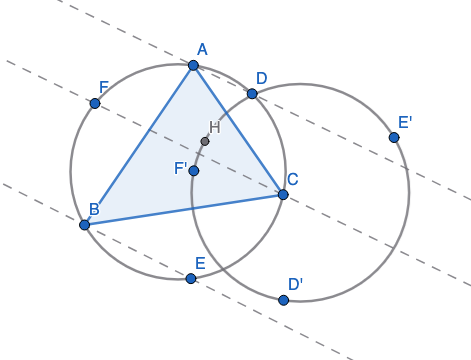
Let \(H\) be the orthocenter of triangle \(\triangle ABC\) (i.e: the point where the three heights meet). Let \(D,E,F\) be three points on the circumcircle of \(\triangle ABC\) such that lines \(\overline{AD}, \overline{FC}, \overline{BE}\) are all parallel to each other. Then, let \(D',E',F'\) be obtained by reflecting \(D,E,F\) across \(BC,CA,AB\) respectively. Prove that the points \(H,D',E',F'\) all lie on the same circle.