Problems
Each student chooses at least one from the \(n\) different modules offered at a university. Let us number these modules as \(1,2,3,\dots,n\). For each natural number \(1\leq k\leq n\), we denote the number of students choosing the modules \(i_1,\dots,i_k\) by \(S(i_1,\dots,i_k)\). Give a formula for the number of students in terms of the numbers \(S(i_1,\dots,i_k)\).
As an example, if \(n = 5\), \(k=3\) and we look at \(i_1 = 4,i_2 = 2, i_3 =1\), then \(S(i_1,i_2,i_3) = S(4,2,1)\) is the number of students picking the modules \(1,2,4\).
There are \(n\) seats on a plane and each of the \(n\) passengers sat in the wrong seat. What is the total number of ways this could happen?
Let \(n\geq 2\) be an integer. Fix \(2n\) points in space, so that no four points lie on a common plane. Suppose there are \(n^2+1\) segments between these points. Show that these segments must form at least \(n\) triangles.
Elections are approaching in Problemland! There are three candidates for president: \(A\), \(B\), and \(C\).
An opinion poll reports that \(65\%\) of voters would be satisfied with \(A\), \(57\%\) with \(B\), and \(58\%\) with \(C\). It also says that \(28\%\) would accept \(A\) or \(B\), \(30\%\) \(A\) or \(C\), \(27\%\) \(B\) or \(C\), and that \(12\%\) would be content with all three candidates.
Show that there must have been a mistake in the poll.
You are creating passwords of length \(8\) using only the letters \(A\), \(B\), and \(C\). Each password must use all three letters at least once.
How many such passwords are there?
How many numbers from \(1\) to \(1000\) are divisible by \(2\) or \(3\)?
Three kinds of cookies are sold at a store: dark chocolate \((D)\), raspberry with white chocolate \((R)\) and honeycomb \((H)\). Here is a table summarizing the number of people buying cookies this morning.
| \(D\) | \(R\) | \(H\) | \(D, R\) | \(D,H\) | \(R,H\) | \(D,R,H\) | |
|---|---|---|---|---|---|---|---|
| Number of people | 16 | 16 | 10 | 7 | 5 | 3 | 1 |
The column with label \(D,H\), for example, means the number of people who bought both dark chocolate and honeycomb cookies.
How many people bought cookies this morning?
At the space carnival, visitors can try two special attractions: the Zero-Gravity Room or the Laser Maze. By the end of the day:
\(100\) visitors have tried at least one of the two attractions,
\(50\) visitors tried the Laser Maze,
\(20\) visitors tried both attractions.
How many visitors tried only the Zero-Gravity Room?
We write all \(26\) different letters of the English alphabet in a line, using each letter exactly once.
How many such arrangements do not contain any of the strings
fish, rat, or bird?
For a trapezium \(ABCD\), let \(E\) be the point of intersection of the sides \(AB\) and \(CD\), and let the point \(G\) be the point of intersection of the diagonals of the trapezium. Finally, let \(F\) amd \(H\) be the midpoints of the sides \(BC\) and \(AD\) respectively.
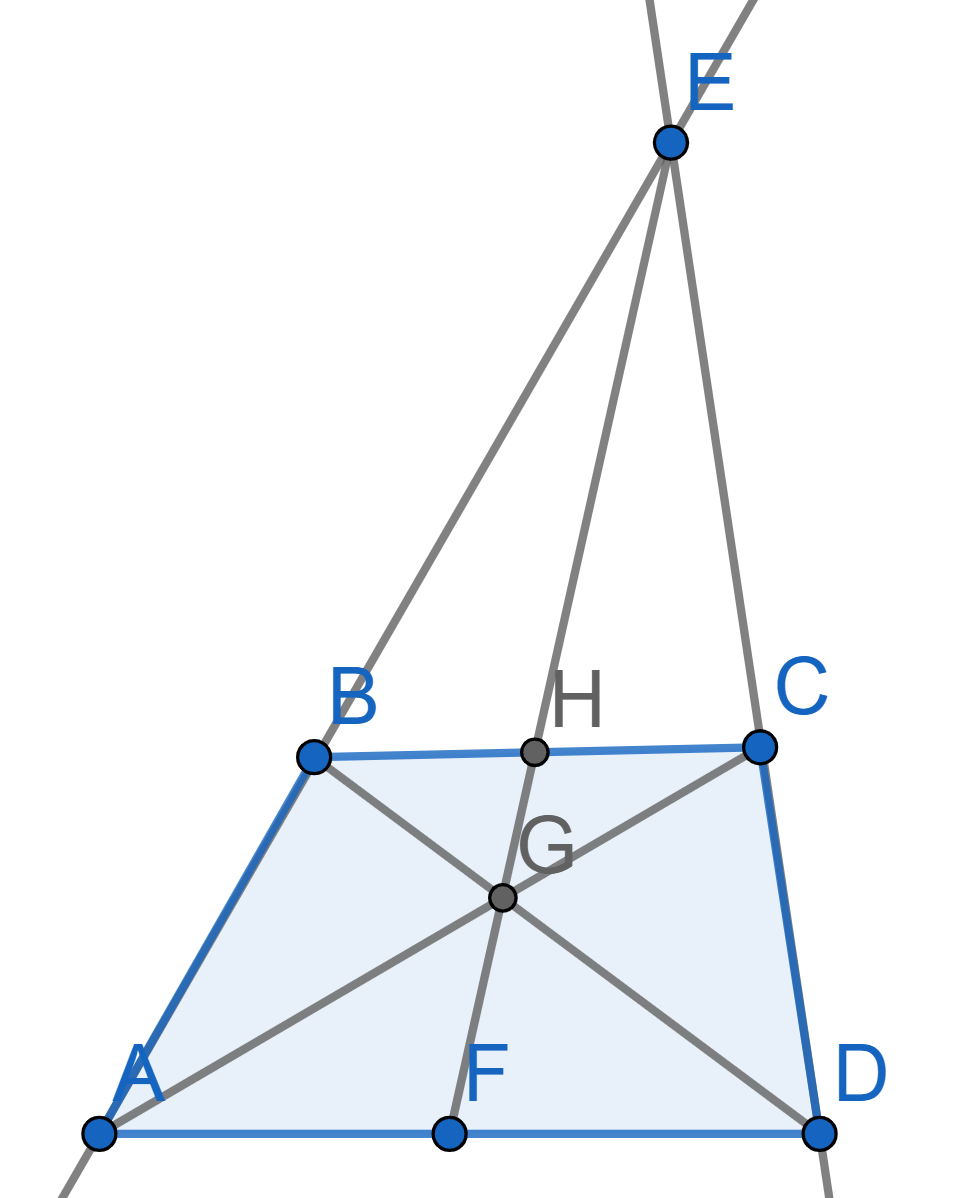
Prove that the points \(E,F,G,H\) lie on one line.