Problems
(USAMO 1997) Let \(p_1, p_2, p_3,\dots\) be the prime numbers listed in increasing order, and let \(0 < x_0 < 1\) be a real number between 0 and 1. For each positive integer \(k\), define \[x_k = \begin{cases} 0 & \text{ if } x_{k-1} = 0 \\ \left\{\frac{p_k}{x_{k-1}} \right\} & \text{ if } x_{k-1} \neq 0 \end{cases}\] where \(\{x\}\) denotes the fractional part of \(x\). For example, \(\{2.53\} = 0.53\) and \(\{3.1415926...\} = 0.1415926...\). Find, with proof, all \(x_0\) satisfying \(0 <x_0 <1\) for which the sequence \(x_0, x_1, x_2,\dots\) eventually becomes 0.
Take the number \(2026^{2026}\). We remove the leading digit and add it to the remaining number. This action is repeated until there are exactly \(10\) digits left. Show that there must be two digits that are the same in the end.
George is cutting a birthday cake into various numbers of pieces. If he cuts the cake or a piece of cake into only two parts, then those part must have equal weight. However, if he cuts the cake into more than two pieces, then those pieces can be of any weight, but they all must have different integer masses. After some operations he managed to cut the cake into \(N\) pieces. Is it true that for any \(N\geq 10\) it could be that all the pieces are of the same weight?
Show that the following pattern eventually dies completely:

A still life is a non-empty pattern (it starts with at least one alive cell) that never changes. Show that a pattern consisting of a \(2\times 2\) square of alive cells is a still life.
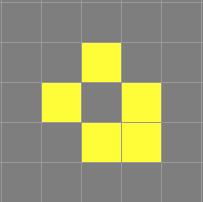
An oscillator is a pattern that returns to its original state after some number of evolutions. Its period is the smallest number of generations it needs to return to its initial state, so for example, a still life has period \(1\) because after \(1\) generation, it looks just like before. Show that a \(3\times 1\) rectangle of alive cells is an oscillator, and find its period.
What is the smallest number of alive cells that a pattern needs to start with in order for the pattern to never die off?
A connected still life is a still life where you can get from any alive cell to any other alive cell by moving through neighbouring alive cells (remember that cells may touch at corners and still count as connected), Find a connected still life of exactly \(10\) alive cells.
Show that for any given even number greater than or equal to \(4\), there is a connected still life with that number of alive cells.