Problems
Many magicians can perform what is known as the Faro shuffle. Actually there are two kinds of Faro shuffle: the in Faro shuffle and the out Faro shuffle.
Let us assume that the deck has an even number of cards. The first step of the Faro shuffle is to divide the deck into two smaller decks of equal size. One deck consist of the top half of the original deck in their original order. The other deck consists of the bottom half of the original deck in their original order.
The second step of the Faro shuffle is to interweave the two decks, so that each card is above and beneath a card of the opposite deck. This is where the in Faro and the out Faro differ: the in Faro changes the top and bottom cards of the original deck (from before step one) while the out Faro retains the original top and bottom cards.
Show that only 8 out Faro shuffles are needed to return a standard 52 card deck back into its original position.
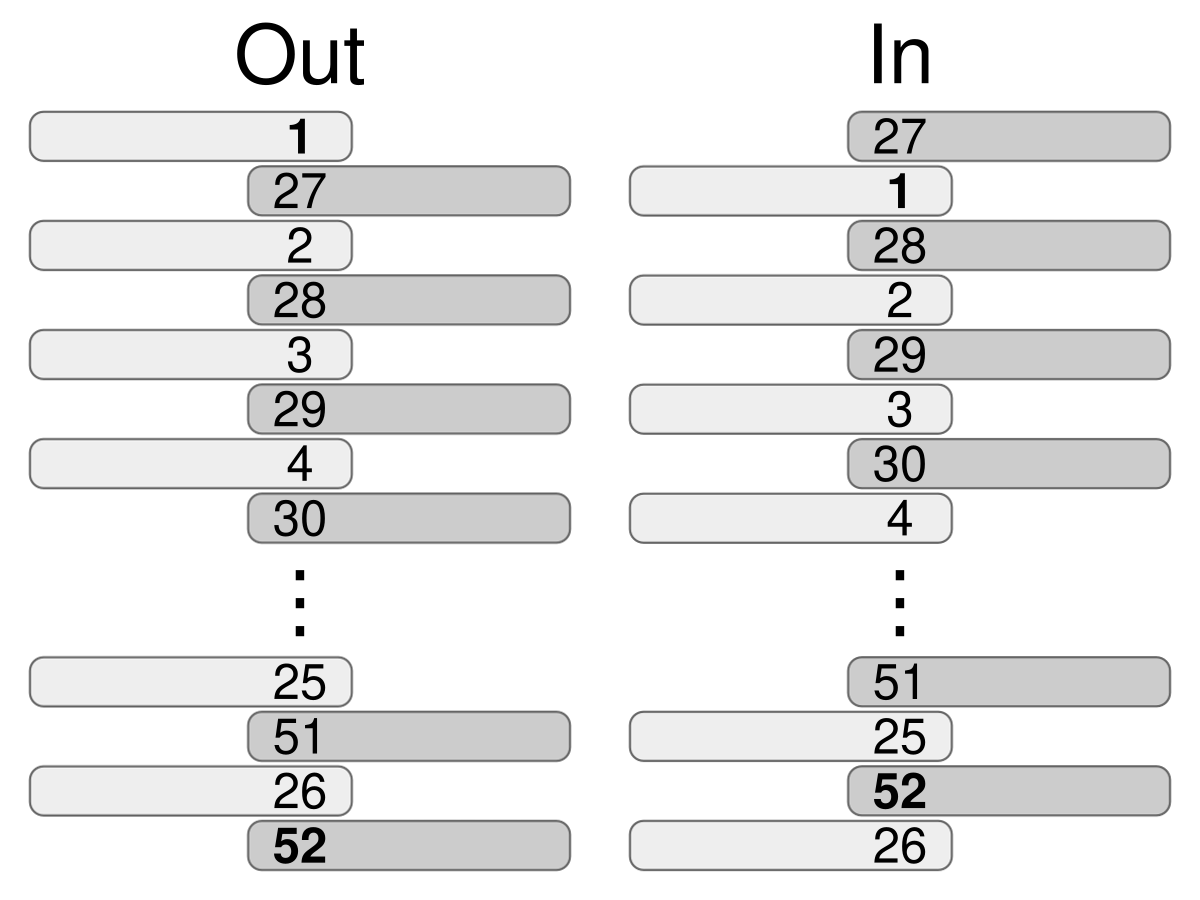
How can you move the top card to any position in an even size deck using only Faro shuffles?
You have a deck of \(n\) distinct cards. Deal out \(k\) cards from the top one by one and put the rest of the deck on top of the \(k\) cards. What is the minimum number of times you need to repeat the action to return every card back to its position?
Let \(ABC\) be a triangle with midpoints \(D\) on the side \(BC\), \(E\) on the side \(AC\), and \(F\) on the side \(AB\). Prove that the perpendicular bisectors to the sides \(AB\), \(BC\), \(AC\) intersect at one point.
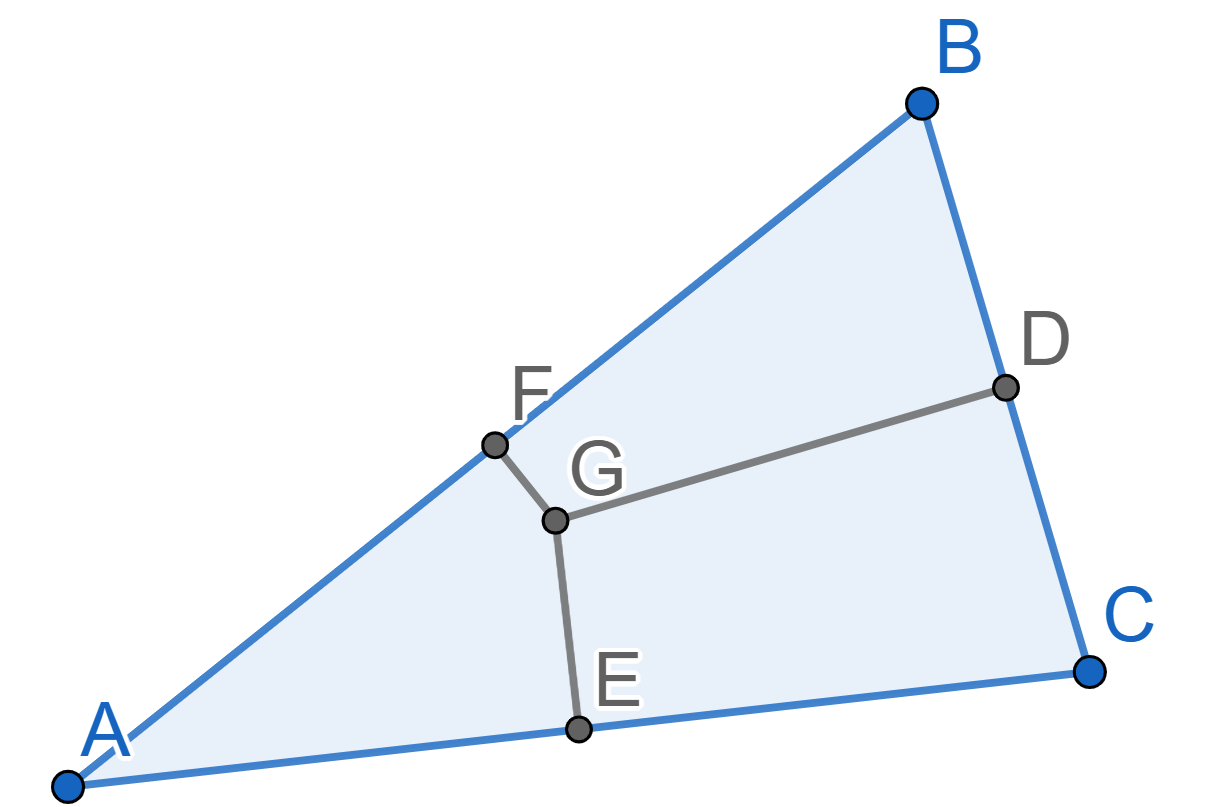
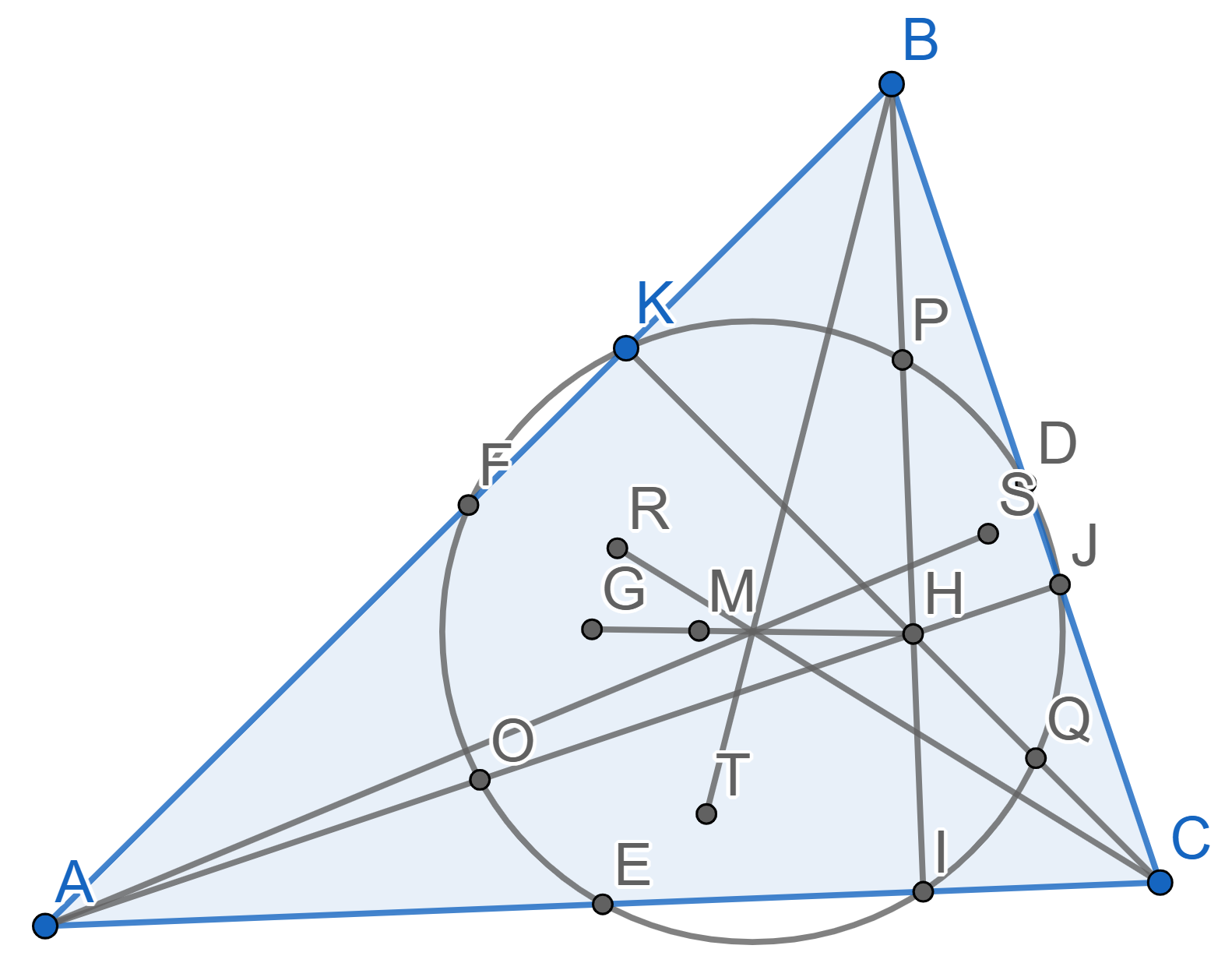
Let \(ABC\) be a triangle with midpoints \(D\) on the side \(BC\), \(E\) on the side \(AC\), and \(F\) on the side \(AB\). Let \(M\) be the point of intersection of all medians of the triangle \(ABC\), let \(H\) be the point of intersection of the heights \(AJ\), \(BI\) and \(CK\). Prove that the points \(D\), \(J\), \(I\), \(E\), \(F\) and \(K\) all lie on one circle.
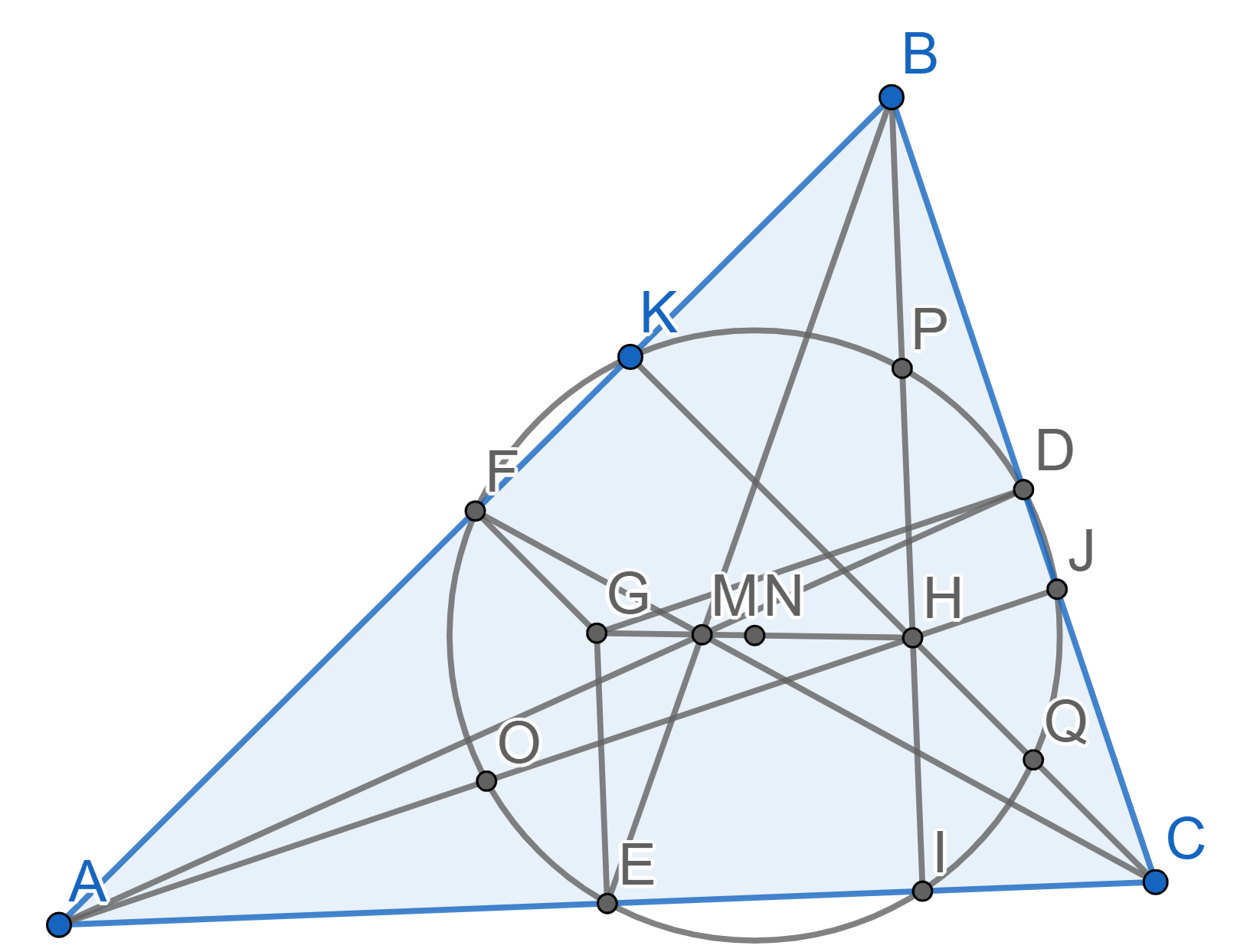
Let \(ABC\) be a triangle with midpoints \(D\) on the side \(BC\), \(E\) on the side \(AC\) and \(F\) on the side \(AB\). Let \(M\) be the point of intersection of all medians of the triangle \(ABC\) and let \(H\) be the point of intersection of the heights \(AJ\), \(BI\) and \(CK\). Consider the Euler circle of the triangle \(ABC\), which is the one that contains the points \(D,J,I,E,F,K\). This circle intersects the segments \(AH\), \(BH\) and \(CH\) at the points \(O\), \(P\) and \(Q\) respectively. Prove that \(O\), \(P\) and \(Q\) are the midpoints of the segments \(AH\), \(BH\) and \(CH\).
Consider the point \(H\) of intersection of the heights of the triangle \(ABC\). Prove that Euler lines of the triangles \(ABC\), \(ABH\), \(BCH\) and \(ACH\) intersect at one point. On the diagram below the points \(R,S,T\) are the points of intersection of medians in triangles \(ABH\), \(BCH\), and \(ACH\) respectively.
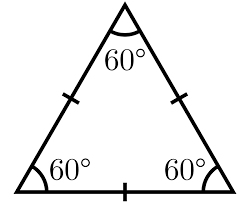
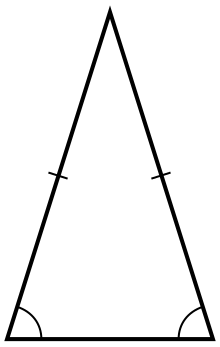
What are the symmetries of an isosceles triangle (which is not equilateral)?
What are the symmetries of the reduce-reuse-recycle symbol?