Problems
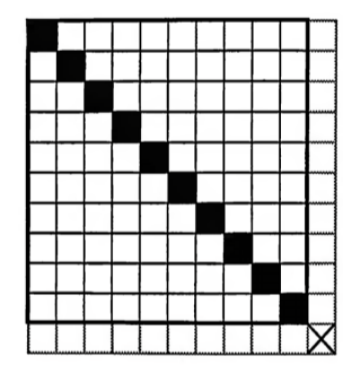
For natural numbers \(n\) and \(k\) with \(k\leq n\), the notation \({n\choose k}\) means the number of ways one can choose \(k\) objects from a set of \(n\) objects when the ordering does not matter. Explain how the diagram below gives a visual proof of the fact that \[{n+1\choose 2}={n\choose 2}+n.\]
For a real number \(x\), we call \(|x|\) its absolute value. It is defined as whichever is larger: \(x\) or \(-x\). For example, \(|-2|=2\) and \(|3|=3\).
One of the most important inequalities involving absolute values is the triangle inequality, which states that \[|a+b| \le |a| + |b|.\]
Show that this inequality is true.
Let \(z\) be a complex number. Show that
For a real number \(k\), \(|kz|=|k|\cdot |z|\).
\(|iz|=|z|\).
Consider a right-angled triangle and let \(\theta\) be one of its acute angles. We define the sine of \(\theta\), written \(\sin(\theta)\), as the length of the side opposite to \(\theta\) divided by the length of the hypotenuse. Similarly, we define the cosine of \(\theta\), written \(\cos(\theta)\), as the length of the side adjacent to \(\theta\) divided by the length of the hypotenuse.
Now take a right-angled triangle with acute angle \(\alpha\), and on its hypotenuse build another right-angled triangle with acute angle \(\beta\). Use the resulting diagram to show that \(\sin(\alpha+\beta)=\sin(\alpha)\cos(\beta)+\sin(\beta)\cos(\alpha)\).