Problems
In the following puzzle, different animals represent different digits, and your goal is to find which digit each animal represents.

Find all possible solutions.
What is the smallest positive whole number whose digits add up to \(2026\)?
The thirteen dwarves sat down around a bonfire in a circle, and their leader Thorin proposed a challenge to pass the time:
Each dwarf would choose an integer (it is not necessary that each dwarf chooses a different number) so that for every group of three neighboring dwarves, the sum of their numbers must be exactly \(13\).
Does Thorin’s challenge have a solution?
In the month of January of a certain year, there are exactly \(4\) Mondays and \(4\) Fridays. What day of the week is the \(20^{\text{th}}\) day of this month?
We would like to place the numbers \(1\) to \(10\) into the circles in the picture below, using each number exactly once, so that for every straight line of three circles, the numbers in those circles add up to the same total. Is this possible?
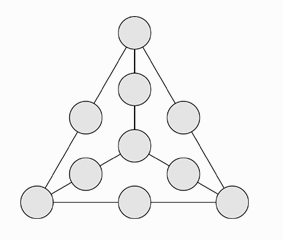
We have a \(17\) digit number, and we form a new number by reading the original number from right to left (if this produces a leading zero, we simply ignore this leading zero, giving a \(16\) digit number). We add this new number to the original number. Show that this resulting sum will have at least one even digit.
Which of the two following numbers is larger: \(31^{11}\) or \(17^{14}\)?
There are \(2026\) people at a big party. Some pairs of people are friends (nobody is friends with themselves, and friendship goes both ways). Starting one minute after midnight, the host begins sending people home in a strange way.
After 1 minute, anyone with no friends at the party leaves. After 2 minutes, anyone with exactly one friend currently in the party leaves. After 3 minutes, anyone with exactly two friends currently in the party leaves, and so on.
(Important: at each minute, everyone checks their number of friends at the same time, and then all the people who qualify leave together.)
Show that after \(2026\) minutes have passed, at least two people will have left the party.
Zippity the robot speaks a language of \(n\) words which can be written with \(0\)s and \(1\)s. In this language, no word appears as the first several digits of another word. For example: if “\(1001\)” is a word, then “\(100101\)” can’t be a word. Show that if \(\ell_1,\cdots, \ell_n\) are the lengths of each word (i.e: the number of digits), then \[\frac{1}{2^{\ell_1}}+\frac{1}{2^{\ell_2}}+\cdots + \frac{1}{2^{\ell_n}}\leq 1.\]
You have a \(5\)-liter bucket and a \(3\)-liter bucket, along with an unlimited supply of water.
You are allowed to do only these moves:
fill a bucket completely from the water supply,
empty a bucket completely,
pour water from one bucket into the other until either the first bucket is empty or the second bucket is full.
Find two different ways to end up with exactly \(4\) liters of water (Adding extra steps that don’t change the situation, like filling a bucket and then immediately emptying it again, does not count as finding a new way).