Problems
In the king’s prison, there are five cells numbered from 1 to 5. In each cell, there is one prisoner. Kristen persuaded the king to conduct an experiment: on the wall of each cell she writes at one point a number and at midnight, each prisoner will go to the cell with the indicated number (if the number on the wall coincides with the cell number, the prisoner does not go anywhere). On the following night at midnight, the prisoners again must move from their cell to another cell according to the instructions on the wall, and they do this for five nights. If the location of prisoners in the cells for all six days (including the first) is never repeated, then Kristen will be given the title of Wisdom, and the prisoners will be released. Help Kristen write numbers in the cells.
The \(KUB\) is a cube. Prove that the ball, \(CIR\), is not a cube. (\(KUB\) and \(CIR\) are three-digit numbers, where different letters denote different numbers).
Can I replace the letters with numbers in the puzzle \(RE \times CTS + 1 = CE \times MS\) so that the correct equality is obtained (different letters need to be replaced by different numbers, and the same letters must correspond to the same digits)?
Find \(x^3 +y^3\) if \(x+y=5\) and \(x+y+x^2 y +xy^2 =24\).
On the \(xy\)-plane shown below is the graph of the function \(y=ax^2 +c\). At which points does the graph of the function \(y=cx+a\) intersect the \(x\) and \(y\) axes?
Find the largest natural number \(n\) which satisfies \(n^{200} <5^{300}\).
Does there exist a natural number which, when divided by the sum of its digits, gives a quotient and remainder both equal to the number 2011?
In a herd consisting of horses and camels (some with one hump and some with two) there are a total of 200 humps. How many animals are in the herd, if the number of horses is equal to the number of camels with two humps?
Of the four inequalities \(2x > 70\), \(x < 100\), \(4x > 25\) and \(x > 5\), two are true and two are false. Find the value of \(x\) if it is known that it is an integer.
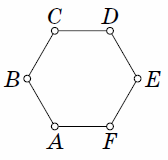
At the vertices of the hexagon \(ABCDEF\) (see Fig.) There were 6 identical balls: at \(A\) – one with mass 1 g, at \(B\) – 2 g, ..., at \(F\) – 6 g. Callum changed the places of two balls in opposite vertices. A set of weighing scales with 2 plates is available, which let you know which plate contains the balls of greater mass. How, in one weighing, can it be determined which balls were rearranged?