Problems
There are \(16\) cubes, each face of every cube is coloured yellow, black, or red (different cubes can be coloured differently). After looking at their colouring pattern, Pinoccio said that he could put all the cubes on the table in such a way that only the yellow color would be visible, on the next turn he could put the cubes in such a way that only the black color would be visible, and also he could put them in such a way that only the red color would be visible. Is there a colouring of the cubes such that he could tell the truth?
Alex writes natural numbers in a row: \(123456789101112...\) Counting from the beginning, in what places do the digits \(555\) first appear? For example, \(101\) first appears in the 10th, 11th and 12th places.
Find the representation of \((a+b)^n\) as the sum of \(X_{n,k}a^kb^{n-k}\) for general \(n\). Here by \(X_{n,k}\) we denote coefficients that depend only on \(k\) and \(n\).
The positive real numbers \(a, b, c, x, y\) satisfy the following system of equations: \[\left\{ \begin{aligned} x^2 + xy + y^2 = a^2\\ y^2 + yz + z^2 = b^2\\ x^2 + xz + z^2 = c^2 \end{aligned} \right.\]
Find the value of \(xy + yz + xz\) in terms of \(a, b,\) and \(c.\)
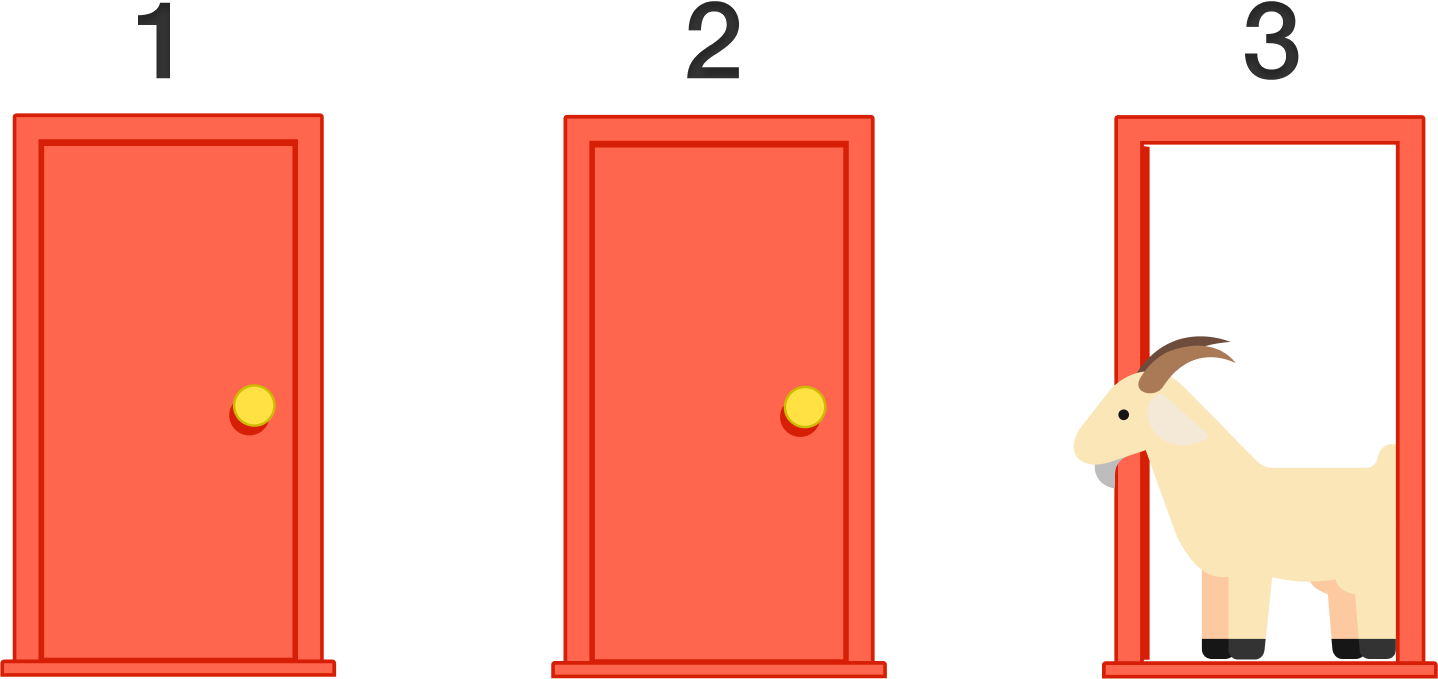
This is a famous problem, called Monty Hall problem after a popular
TV show in America.
In the problem, you are on a game show, being asked to choose between
three doors. Behind each door, there is either a car or a goat. You
choose a door. The host, Monty Hall, picks one of the other doors, which
he knows has a goat behind it, and opens it, showing you the goat. (You
know, by the rules of the game, that Monty will always reveal a goat.)
Monty then asks whether you would like to switch your choice of door to
the other remaining door. Assuming you prefer having a car more than
having a goat, do you choose to switch or not to switch?
Find a representation as a product of \(a^{2n+1} + b^{2n+1}\) for general \(a,b,n\).
Each integer on the number line is coloured either white or black. The numbers \(2016\) and \(2017\) are coloured differently. Prove that there are three identically coloured integers which sum to zero.
There are \(100\) non-zero numbers written in a circle. Between every two adjacent numbers, their product was written, and the previous numbers were erased. It turned out that the number of positive numbers after the operation coincides with the amount of positive numbers before. What is the minimum number of positive numbers that could have been written initially?
Let \(r\) be a rational number and
\(x\) be an irrational number (i.e. not
a rational one). Prove that the number \(r+x\) is irrational.
If \(r\) and \(s\) are both irrational, then must \(r+s\) be irrational as well?
Definition: We call a number \(x\) rational if there exist two
integers \(p\) and \(q\) such that \(x=\frac{p}{q}\). We assume that \(p\) and \(q\) are coprime.
Prove that \(\sqrt{2}\) is not
rational.