Problems
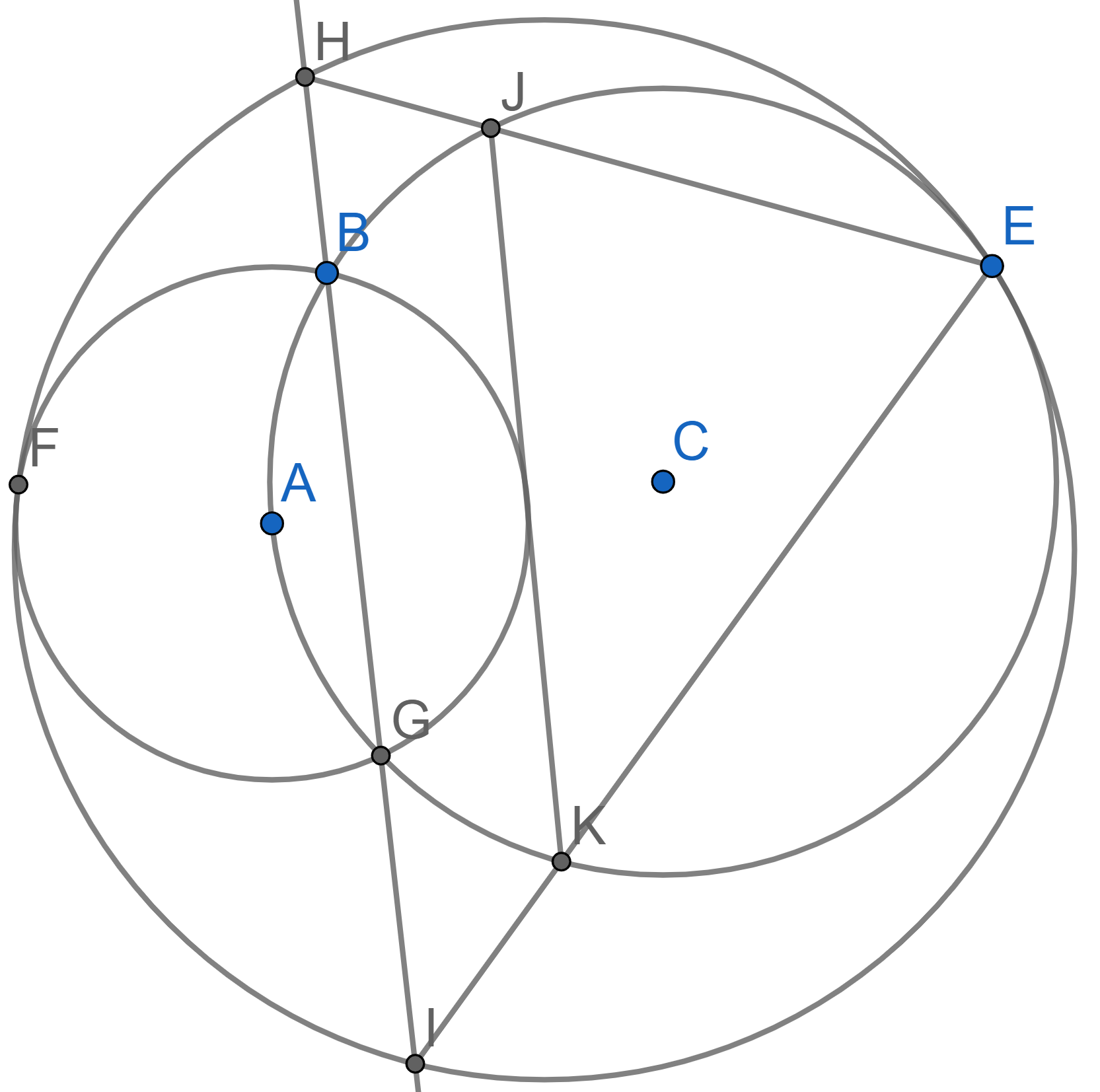
(IMO 1999) Two circles with centres \(A\) and \(C\) intersect at the points \(B\) and \(G\), moreover the circle with centre \(C\) goes through \(A\). A big circle is tangent to both given circles at the points \(E\) and \(F\) (see picture). The line \(BG\) intersects the big circle at the points \(H\) and \(I\). The segments \(EH\) and \(EI\) intersect with the circle with centre \(C\) at the points \(H\) and \(K\) respectively. Prove that the segment \(JK\) is tangent to the circle with center at \(A\).
On the first day Robinson Crusoe tied the goat with a single piece of rope by putting one peg into the ground. What shape did the goat graze?
An equilateral triangle is drawn on a whiteboard and a point \(P\) is drawn somewhere inside this triangle. Show that regardless of where \(P\) is drawn (as long as its inside the triangle), the sum of the distances from \(P\) to each of the sides of the triangle will always be the same.
A teacher saw the calculation \(3\times 4 = 10\) written on the whiteboard. She was about to erase it, thinking it was wrong, but then wondered whether it might have been written in a different numeral system.
Is it possible that this multiplication is correct in some base? If so, which one?
On a distant planet called Hexaris, there live two alien species: the Blipnors and the Quantoodles.
The chief alien writes on a board: “There are \(100\) aliens on this planet. Of these, \(24\) are Blipnors and \(32\) are Quantoodles.”
At first this seems confusing — the numbers do not seem to add up! Then you remember that the aliens use a different base for their numeral system.
What base are they using?
Take the numbers \(0,1,2,\dots,3^k-1\), where \(k\) is a whole number.
Show that you can pick \(2^k\) of these numbers so that, among the numbers you picked, no number is the average of two other chosen numbers.
What is the smallest number of weights that allows us to weigh any whole number of grams of gold from \(1\) to \(100\) on a two-pan balance? The weights may be placed only on the left pan.
Three complex number \(a,b,c\) are called affinely independent if whenever \(t,s,u\) are real numbers such that \(ta+sb+uc = 0\) and \(t+s+u=0\), we have that \(t=s=u=0\). Show that three complex numbers \(a,b,c\) are affinely independent if and only if they are not collinear.
Let \(\triangle ABC\) be a triangle and \(A'\) be the midpoint of the side \(BC\). The segment \(AA'\) is a called a median of \(\triangle ABC\). Similarly, there are two more medians constructed from \(B\) and \(C\). Show that the three medians intersect at a point and give a formula for that point in terms of the three vertices. This point is called the centroid of \(\triangle ABC\).
The three altitudes of a triangle intersect at a point called the orthocenter of the triangle. Suppose that the vertices of a \(\triangle ABC\) lie on a circle of radius 1 centered at 0. Show that the centroid, the orthocenter and the circumcenter of \(\triangle ABC\) are collinear. This line is called the Euler line of the triangle. Note that the circumcenter of \(\triangle ABC\) is just 0 by our assumption.