Problems
Show that the consecutive sum of odd numbers from \(1\) until any odd number is a perfect square. For example: \(1+3+5=3^2\), or \(1+3+5+7+9=5^2\).
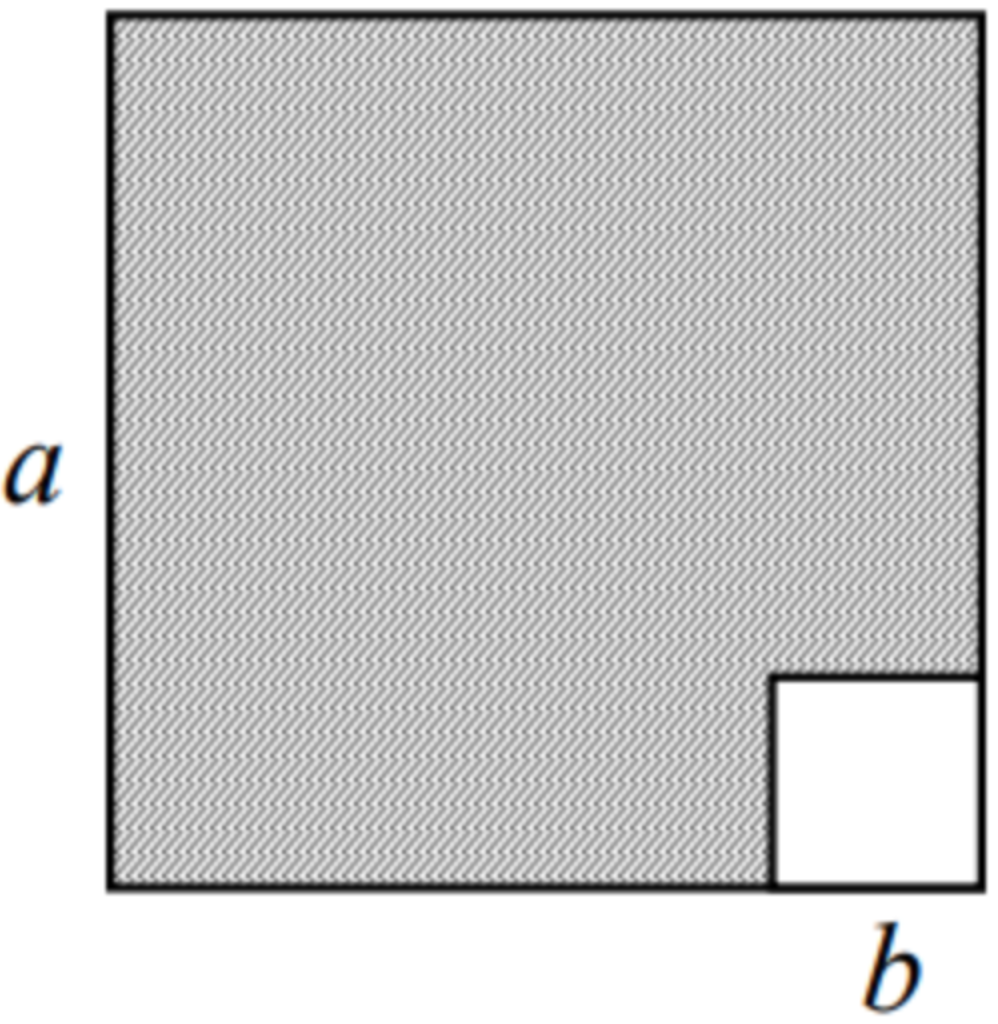
Explain how you can use the diagram below to show that \(a^2-b^2=(a+b)(a-b)\)
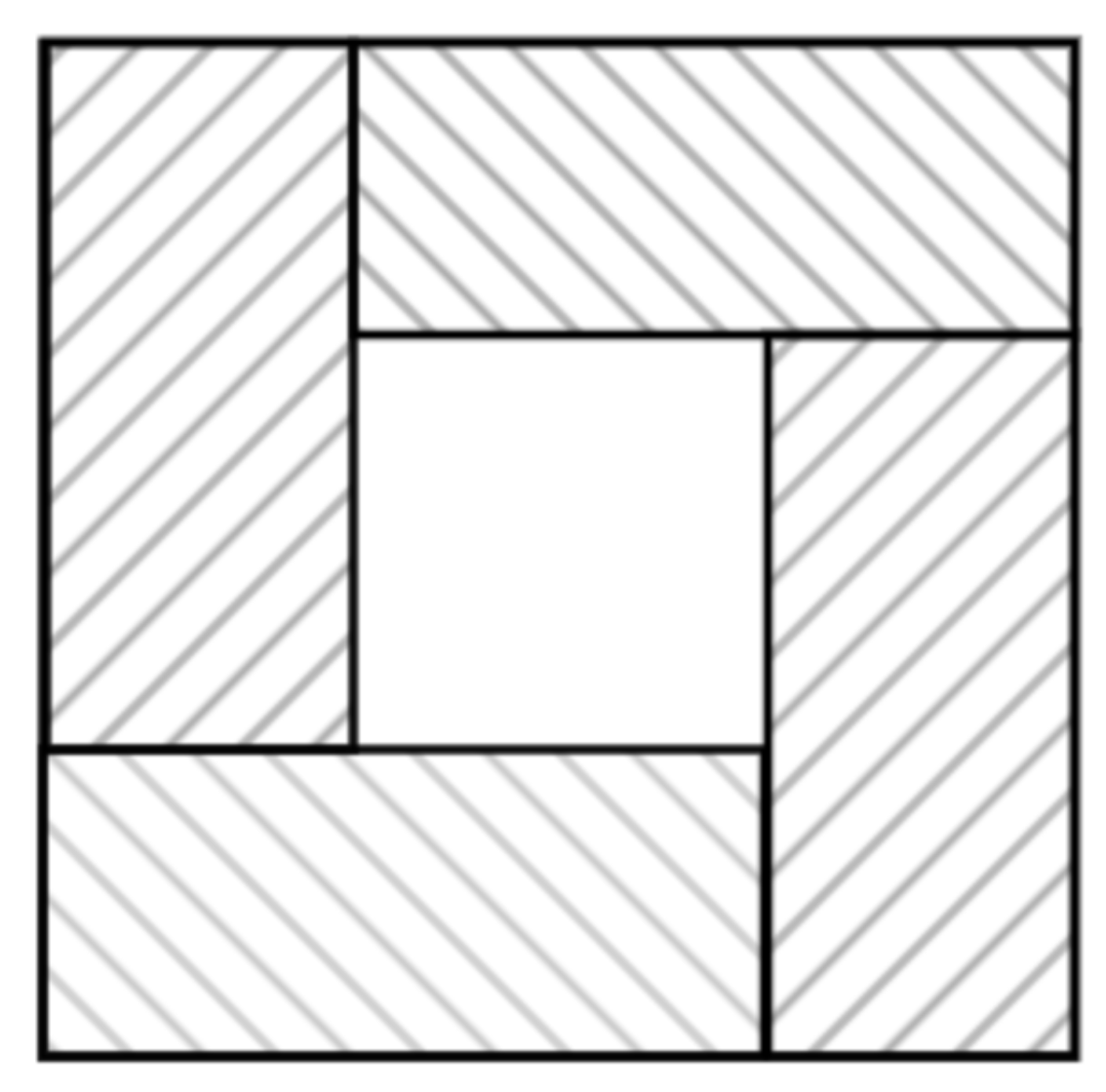
The Arithmetic-Geometric inequality is one of the most famous inequalities. It says that for positive numbers \(a\) and \(b\), \(\frac{a+b}2\geq \sqrt{ab}\). Show this inequality using the diagram below:
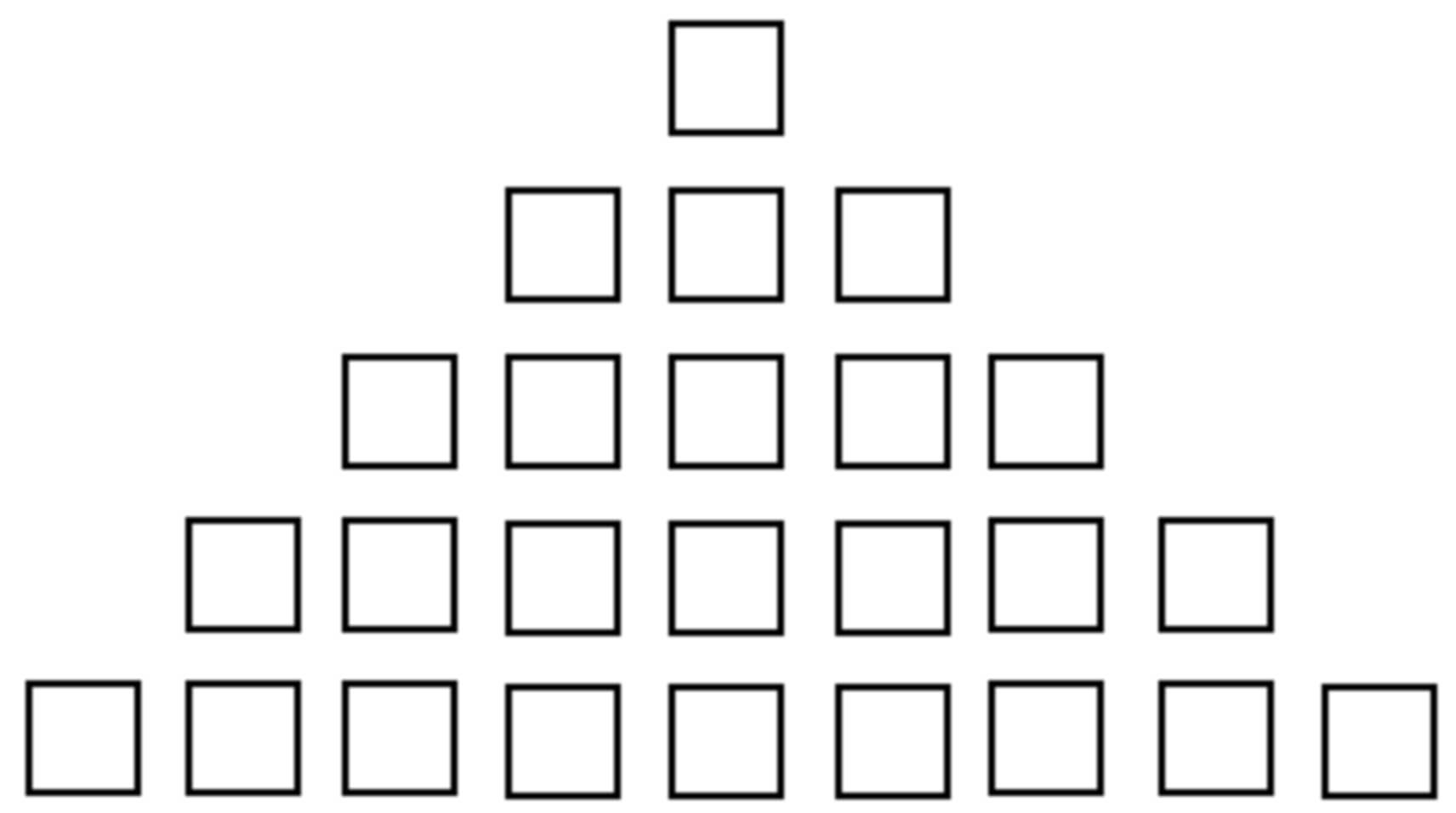
In the examples we showed that the sum of consecutive odd numbers starting from one was a perfect square. Now show how the following diagram can be used to give an alternative proof.
Using the following diagram, show that \(1^3+2^3+3^3+\cdots+n^3=\frac{1}{4}\left(n(n+1)\right)^2\)
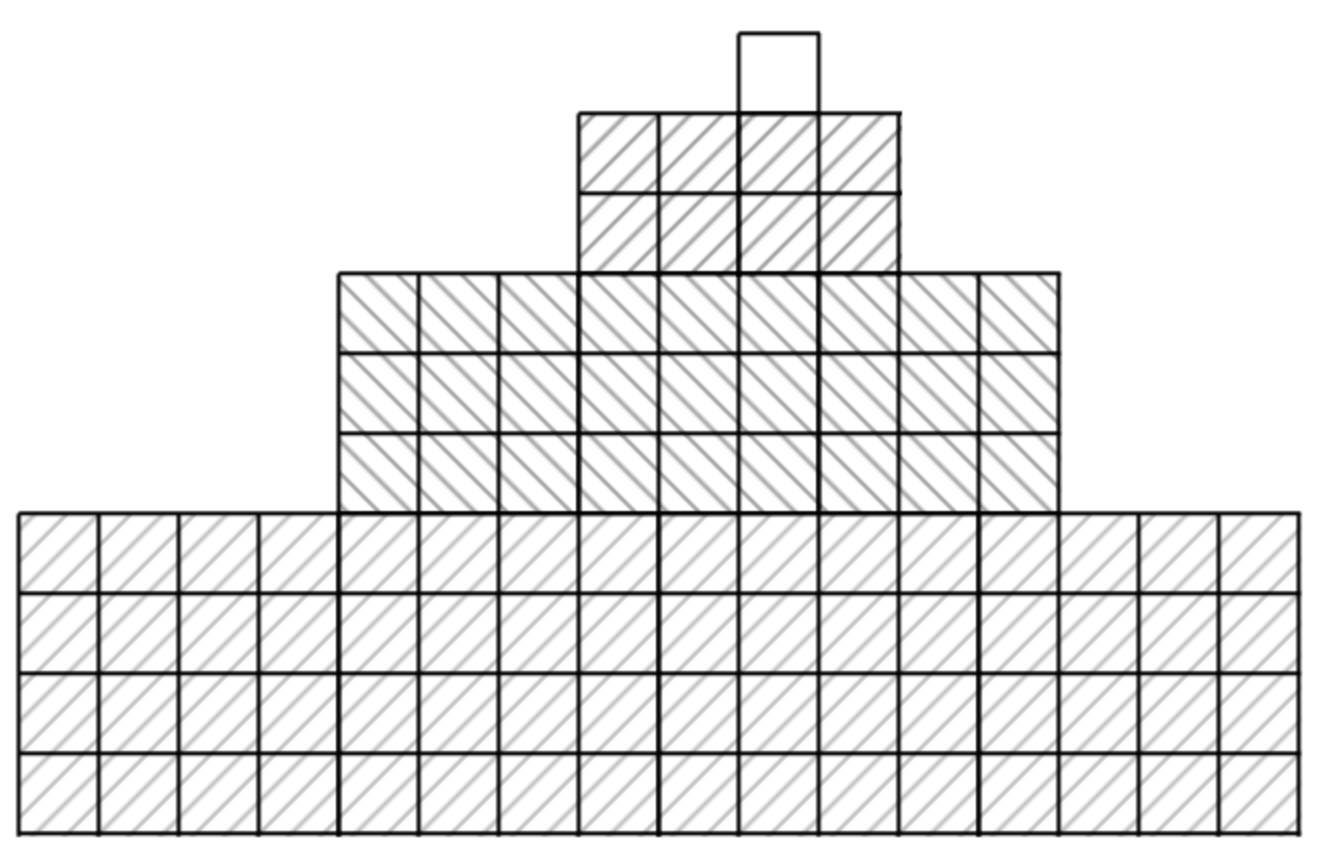
Give a visual proof that the sum of consecutive numbers until \(n\), i.e: \(1+2+\cdots + n\), where \(n\) is some whole number; is equal to \(n(n+1)/2\).
Use a visual proof to find the value of \[\frac{1+3+5+\cdots +2n-1}{(2n+1)+(2n+3)+\cdots + (4n-1)}\] You are not allowed to use the result from the examples to simplify the fraction.
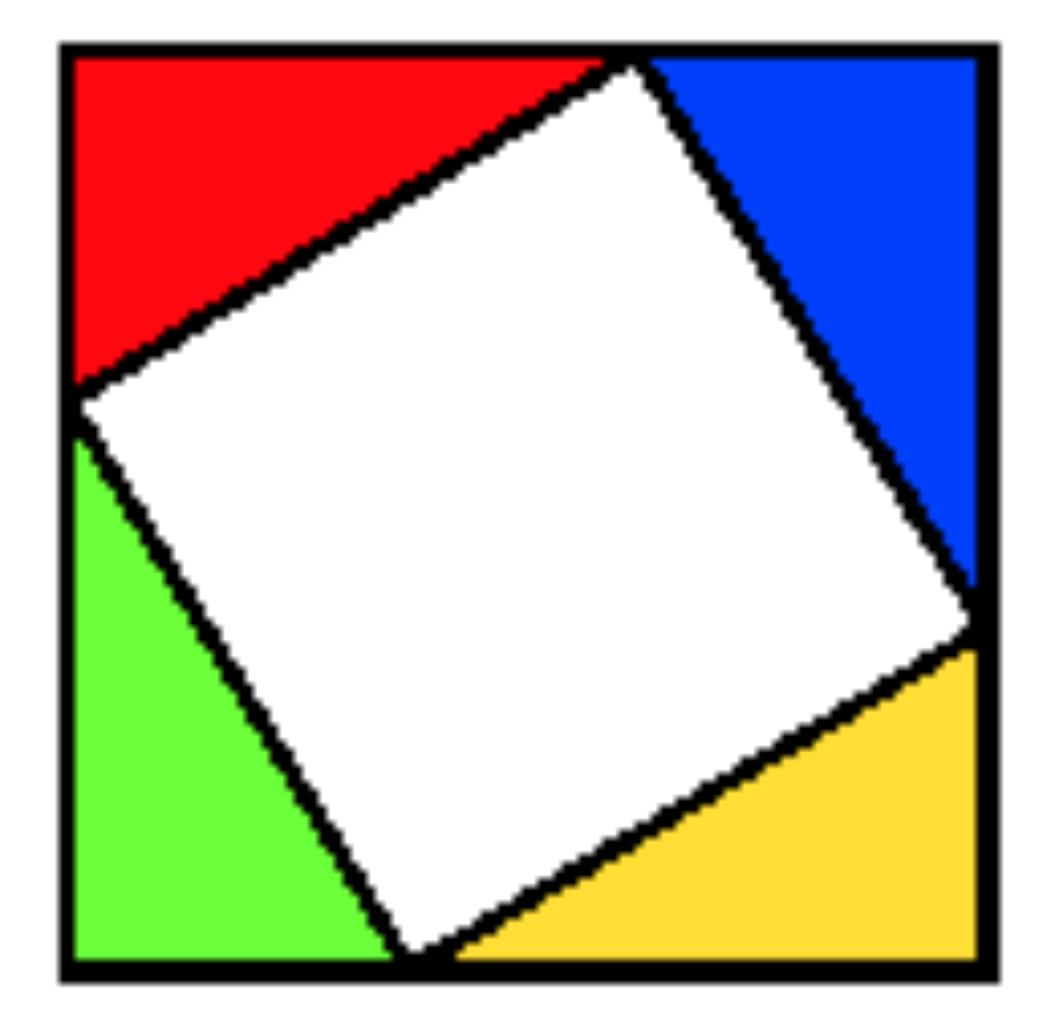
The Pythagorean Theorem is a very useful tool in geometry. It says that if you have a right-angled triangle with sides measuring \(a,b,c\) where \(c\) is the longest side of the three, then \(a^2+b^2=c^2\). Explain how the following diagram gives a visual proof of the Pythagoraen Theorem.