After login you will be able to create your own lists of problems.
Problems
Found: 2383
By cleverly dividing a square of side length \(1\), show that the sum \[\frac{1}{2}+\frac{1}{4}+\frac{1}{8}+\cdots + \frac{1}{1024}= \frac{1023}{1024}\]
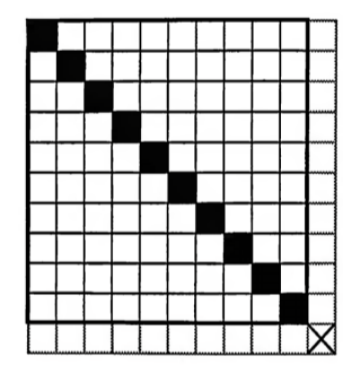
For natural numbers \(n\) and \(k\) with \(k\leq n\), the notation \({n\choose k}\) means the number of ways one can choose \(k\) objects from a set of \(n\) objects. Explain how the diagram below gives a visual proof of the fact that \[{n+1\choose 2}={n\choose 2}+n.\]
For a real number \(x\), we call \(|x|\) its absolute value. It is defined as whichever is larger: \(x\) or \(-x\). For example, \(|-2|=2\) and \(|3|=3\).
One of the most important inequalities involving absolute values is the triangle inequality, which states that \[|a+b| \le |a| + |b|.\]
Show that this inequality is true.