Problems
Find a formula for \(R(2,k)\), where \(k\) is a natural number.
Show that \(R(4,3)\ge9\). That is, there exists a way of colouring the edges of \(K_8\) with no red \(K_4\), nor any blue \(K_3\).
Show that \(R(4,4)\ge18\) - that is, there’s a way of colouring the edges of \(K_{17}\) such that there’s no monochromatic \(K_4\).
Show that \(R(4,3)\le9\). That is, no matter how you colour the edge of \(K_9\), there must be a red \(K_4\) or a blue \(K_3\).
Show that \(R(4,4)\le18\) - that is, no matter how you colour the edges of \(K_{18}\), there must be a monochromatic \(K_4\).
By considering \(k-1\) copies of \(K_{k-1}\), show that \(R(k,k)\ge(k-1)^2\).
Let \(s>2\) and \(t>2\) be integers. Show that \(R(s,t)\le R(s-1,t)+R(s,t-1)\).
Using \(R(s,t)\le R(s-1,t)+R(s,t-1)\), prove that \(R(k,k)\le 4^k\).
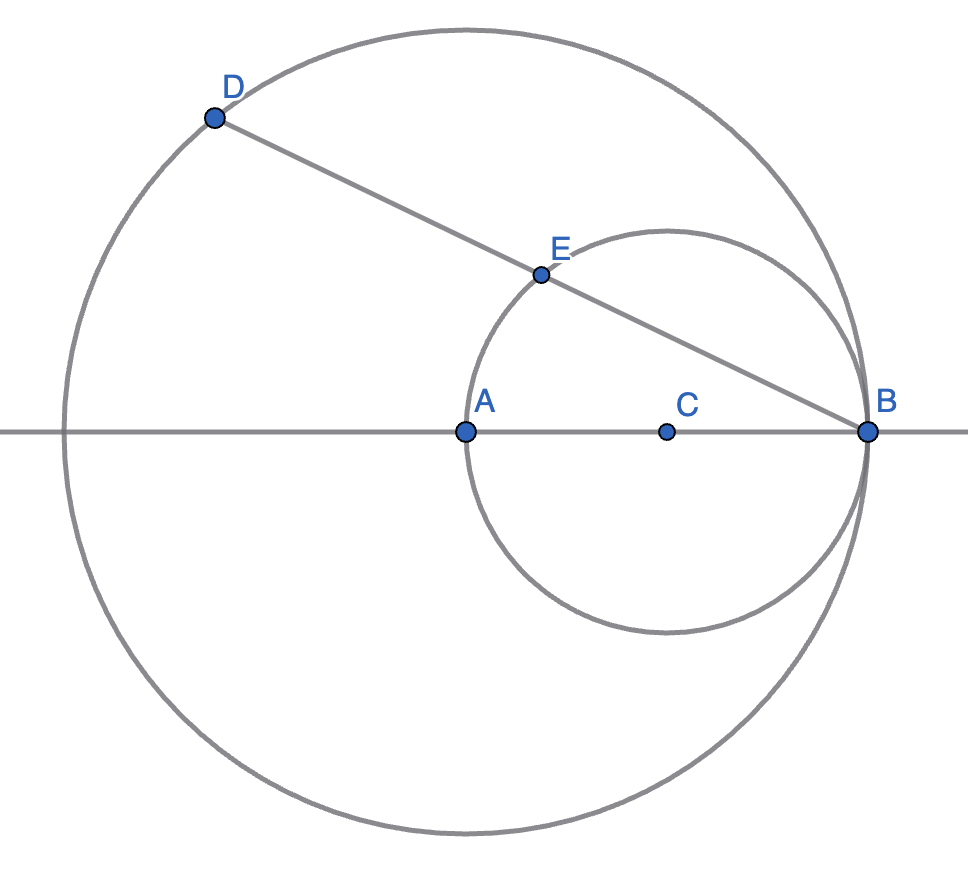
A circle with centre \(A\) has the point \(B\) on its circumference. A smaller circle is drawn inside this with \(AB\) as a diameter and \(C\) as its centre. A point \(D\) (which is not \(B\)) is chosen on the circumference of the bigger circle, and the line \(BD\) is drawn. \(E\) is the point where the line \(BD\) intersects the smaller circle.
Show that \(|BE|=|DE|\).