Problems
You have an \(n\times m\) chocolate bar. You break the bar into two pieces along a line between its squares, then your friend and you take turns (your friend starts) choosing one of the pieces and breaking it again along a line between its squares. The player who cannot make a move loses. For which values of \(n\) and \(m\) do you win?
A still life is a non-empty pattern (it starts with at least one alive cell) that never changes. Show that a pattern consisting of a \(2\times 2\) square of alive cells is a still life.
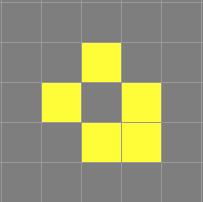
An oscillator is a pattern that returns to its original state after some number of evolutions. Its period is the smallest number of generations it needs to return to its initial state, so for example, a still life has period \(1\) because after \(1\) generation, it looks just like before. Show that a \(3\times 1\) rectangle of alive cells is an oscillator, and find its period.
What is the smallest number of alive cells that a pattern needs to start with in order for the pattern to never die off?
A connected still life is a still life where you can get from any alive cell to any other alive cell by moving through neighbouring alive cells (remember that cells may touch at corners and still count as connected), Find a connected still life of exactly \(10\) alive cells.
Every even number is not prime. The number \(9\) is not an even number, therefore it is not not prime, i.e: the number \(9\) is prime.
The first \(2026\) prime numbers are multiplied. How many zeroes are at the end of this resulting number?
In the following puzzle, different animals represent different digits, and your goal is to find which digit each animal represents.

Find all possible solutions.
You have a \(5\)-liter bucket and a \(3\)-liter bucket, along with an unlimited supply of water.
You are allowed to do only these moves:
fill a bucket completely from the water supply,
empty a bucket completely,
pour water from one bucket into the other until either the first bucket is empty or the second bucket is full.
Find two different ways to end up with exactly \(4\) liters of water (Adding extra steps that don’t change the situation, like filling a bucket and then immediately emptying it again, does not count as finding a new way).