Problems
An equilateral triangle is drawn on a whiteboard and a point \(P\) is drawn somewhere inside this triangle. Show that regardless of where \(P\) is drawn (as long as its inside the triangle), the sum of the distances from \(P\) to each of the sides of the triangle will always be the same.
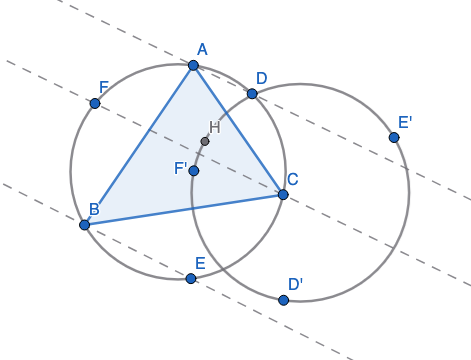
Let \(H\) be the orthocenter of triangle \(\triangle ABC\) (i.e: the point where the three heights meet). Let \(D,E,F\) be three points on the circumcircle of \(\triangle ABC\) such that lines \(\overline{AD}, \overline{FC}, \overline{BE}\) are all parallel to each other. Then, let \(D',E',F'\) be obtained by reflecting \(D,E,F\) across \(BC,CA,AB\) respectively. Prove that the points \(H,D',E',F'\) lie on the same circle.
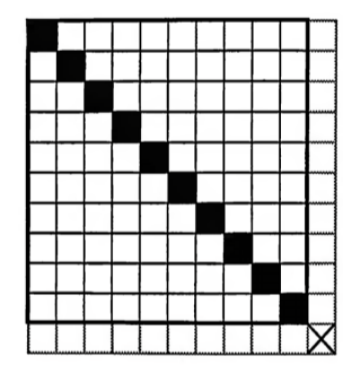
Draw a table with \(n+1\) columns and \(n\) rows, such that each column contains the numbers \(1,2,3,\cdots, n\). Explain how this table can be used to give a visual proof of the following identity \[(1^1\times 1!)\times (2^2\times 2!)\times (3^3\times 3!)\times\cdots \times (n^n\times n!)=(n!)^{n+1}\]
By cleverly dividing a square of side length \(1\), show that the sum \[\frac{1}{2}+\frac{1}{4}+\frac{1}{8}+\frac{1}{16}+\frac{1}{32}+\cdots + \frac{1}{1024}= \frac{1023}{1024}\]
For natural numbers \(n\) and \(k\) with \(k\leq n\), the notation \({n\choose k}\) means the number of ways one can choose \(k\) objects from a set of \(n\) objects when the ordering does not matter. Explain how the diagram below gives a visual proof of the fact that \[{n+1\choose 2}={n\choose 2}+n.\]
Consider a right-angled triangle and let \(\theta\) be one of its acute angles. We define the sine of \(\theta\), written \(\sin(\theta)\), as the length of the side opposite to \(\theta\) divided by the length of the hypotenuse. Similarly, we define the cosine of \(\theta\), written \(\cos(\theta)\), as the length of the side adjacent to \(\theta\) divided by the length of the hypotenuse.
Now take a right-angled triangle with acute angle \(\alpha\), and on its hypotenuse build another right-angled triangle with acute angle \(\beta\). Use the resulting diagram to show that \(\sin(\alpha+\beta)=\sin(\alpha)\cos(\beta)+\sin(\beta)\cos(\alpha)\).
For prime number \(p=4t+1\) the equation \(s^2\equiv -1\) has two distinct solutions in \(\{1,2,...,p-1\}\), for the prime \(p=2\) there is only one solution, for \(p=4t+3\) there are no solutions.