Problems
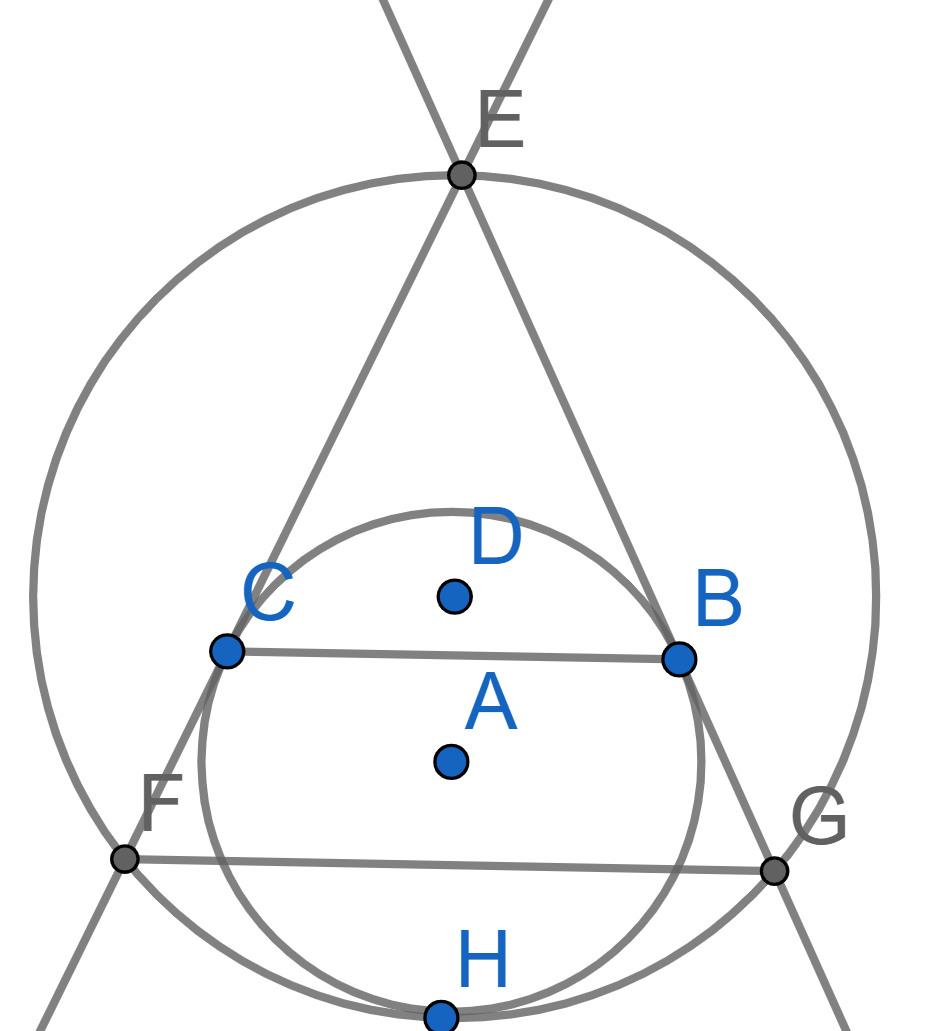
The triangle \(EFG\) is isosceles with \(EF=EG\). A circle with center \(A\) is tangent to the sides \(EF\) and \(EG\) at the points \(C\) and \(B\) respectively. It is also tangent to the circle circumscribed around the triangle \(EFG\) at the point \(H\). Prove that the midpoint of the segment \(BC\) is the center of the circle inscribed into the triangle \(EFG\).
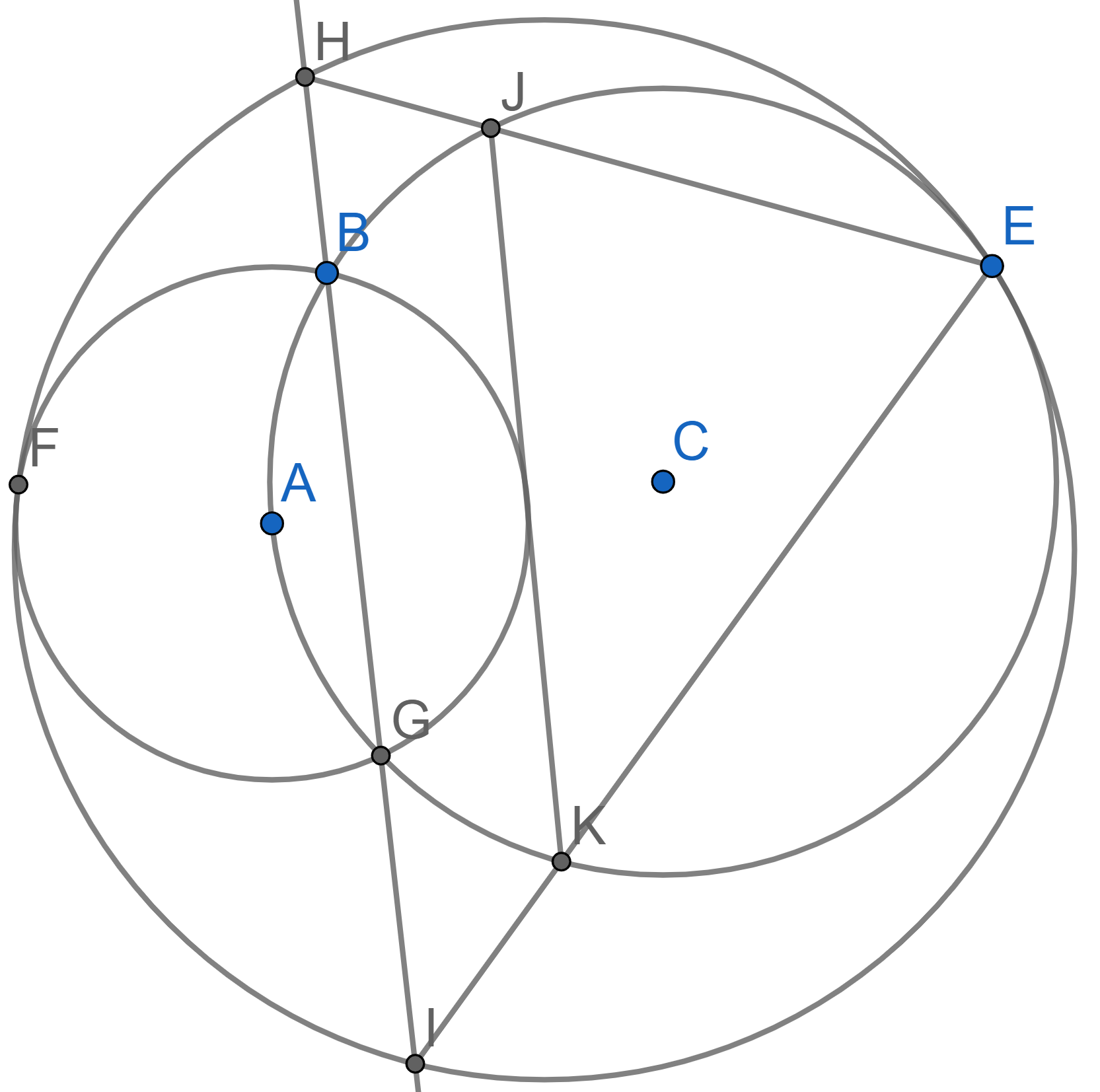
(IMO 1999) Two circles with centres \(A\) and \(C\) intersect at the points \(B\) and \(G\), moreover the circle with centre \(C\) goes through \(A\). A big circle is tangent to both given circles at the points \(E\) and \(F\) (see picture). The line \(BG\) intersects the big circle at the points \(H\) and \(I\). The segments \(EH\) and \(EI\) intersect with the circle with centre \(C\) at the points \(H\) and \(K\) respectively. Prove that the segment \(JK\) is tangent to the circle with center at \(A\).
On the first day Robinson Crusoe tied the goat with a single piece of rope by putting one peg into the ground. What shape did the goat graze?
Euclidean rings: we call a ring "Euclidean" if division with a remainder is possible in the ring. In integer numbers we can divide \(a\) by \(b\) with a remainder if there exist unique \(r\) and \(q\) such that \(r <b\) and \(a=bq+r\), now for Gaussian numbers we need to define what does "\(<\)" mean and what does "unique".
Prove that the division with remainder using the complex norm \(|x+yi| = (x+yi)(x-yi)\) is well defined. Namely for any \(a\) and \(b\) there exist unique (up to multiplicatively invertible element) Gaussian numbers \(q\) and \(r\) with \(|r| <|b|\).
As a corollary (you don’t have to prove but you can use it in later problems) any Gaussian number has a unique (up to \(1,-1,i,-i\)) prime decomposition in \(\mathbb{Z}[i]\).