Problems
Consider a homothety with center \(O\) and coefficient \(k\). Which lines are sent to themselves by this homothety? (Hint: the answer will depend on \(k\))
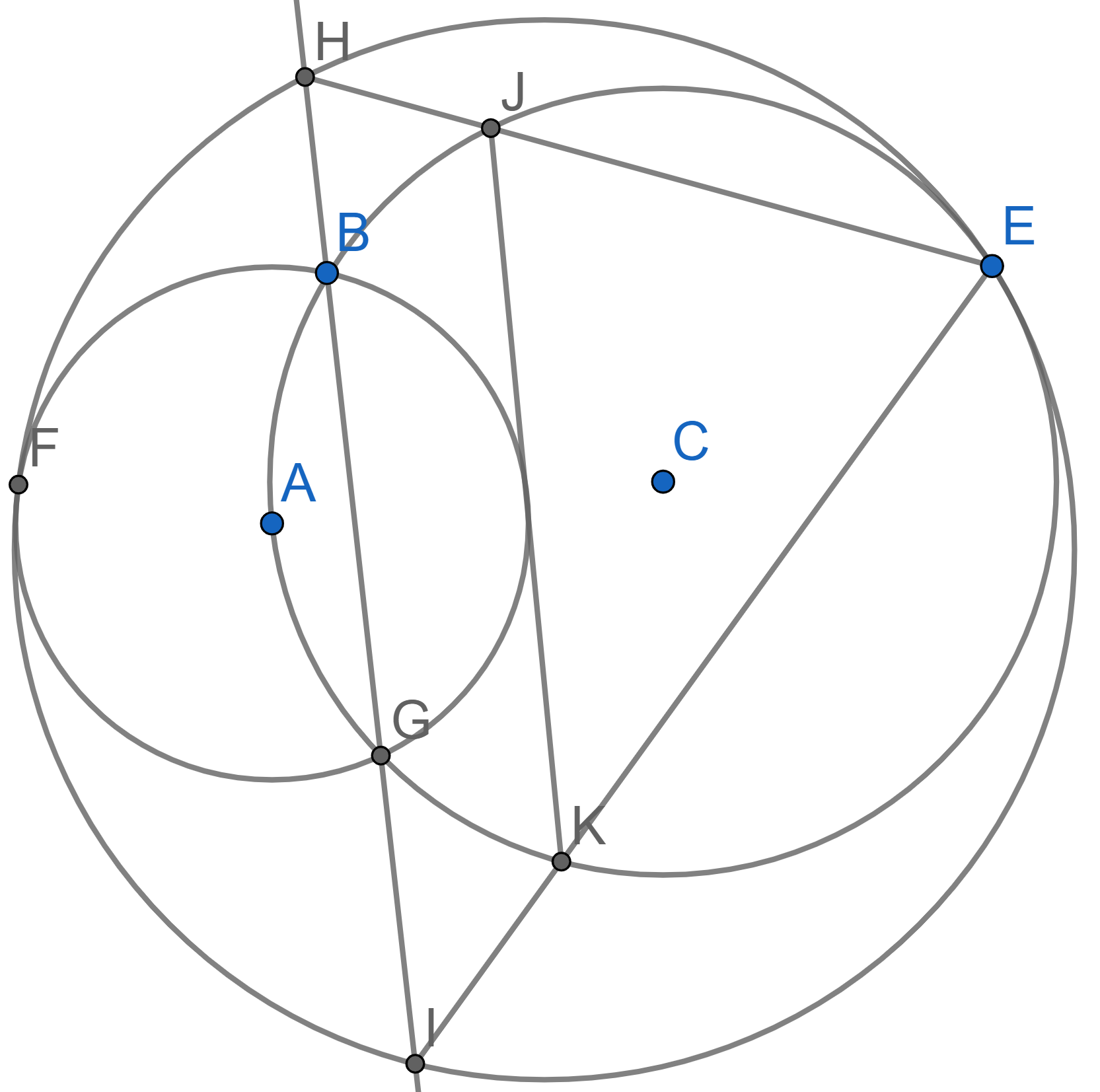
(IMO 1999) Two circles with centres \(A\) and \(C\) intersect at the points \(B\) and \(G\), moreover the circle with centre \(C\) goes through \(A\). A big circle is tangent to both given circles at the points \(E\) and \(F\) (see picture). The line \(BG\) intersects the big circle at the points \(H\) and \(I\). The segments \(EH\) and \(EI\) intersect with the circle with centre \(C\) at the points \(H\) and \(K\) respectively. Prove that the segment \(JK\) is tangent to the circle with center at \(A\).
An equilateral triangle is drawn on a whiteboard and a point \(P\) is drawn somewhere inside this triangle. Show that regardless of where \(P\) is drawn (as long as its inside the triangle), the sum of the distances from \(P\) to each of the sides of the triangle will always be the same.
Consider a right-angled triangle and let \(\theta\) be one of its acute angles. We define the sine of \(\theta\), written \(\sin(\theta)\), as the length of the side opposite to \(\theta\) divided by the length of the hypotenuse. Similarly, we define the cosine of \(\theta\), written \(\cos(\theta)\), as the length of the side adjacent to \(\theta\) divided by the length of the hypotenuse.
Now take a right-angled triangle with acute angle \(\alpha\), and on its hypotenuse build another right-angled triangle with acute angle \(\beta\). Use the resulting diagram to show that \(\sin(\alpha+\beta)=\sin(\alpha)\cos(\beta)+\sin(\beta)\cos(\alpha)\).