Problems
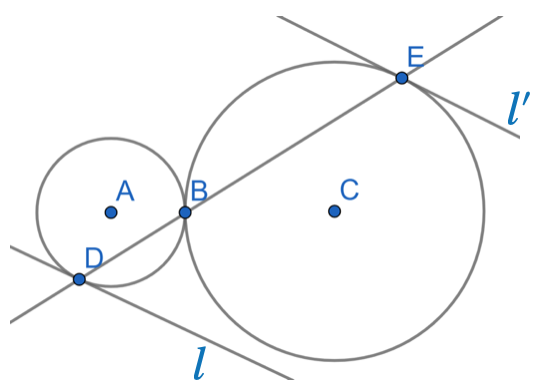
Two circles with centres \(A\) and \(C\) are tangent at the point \(B\). The segment \(DE\) passes through the point \(B\). Prove that the tangent lines \(l\) and \(l'\) passing through the points \(D\) and \(E\) respectively, are parallel.
Let \(ABCD\) be a square, a point
\(I\) a random point on the plane.
Consider the four points, symmetric to \(I\) with respect to the midpoints of \(AB, BC, CD, AD\). Prove that these new four
points are vertices of a square.
In case you need a refresher, we say that a point \(X'\) is symmetric to a point \(X\) with respect to a point \(M\) if \(M\) is the midpoint of the segment \(XX'\).
Let \(ABCD\) be a quadrilateral whose diagonals intersect at a point \(E\).
Consider the four triangles \(ABE\), \(BCE\), \(CDE\), and \(ADE\). For each triangle, draw its medians, and let \(K\), \(J\), \(M\), and \(L\) be the points where the medians intersect in the triangles \(ABE\), \(BCE\), \(CDE\), and \(ADE\), respectively.
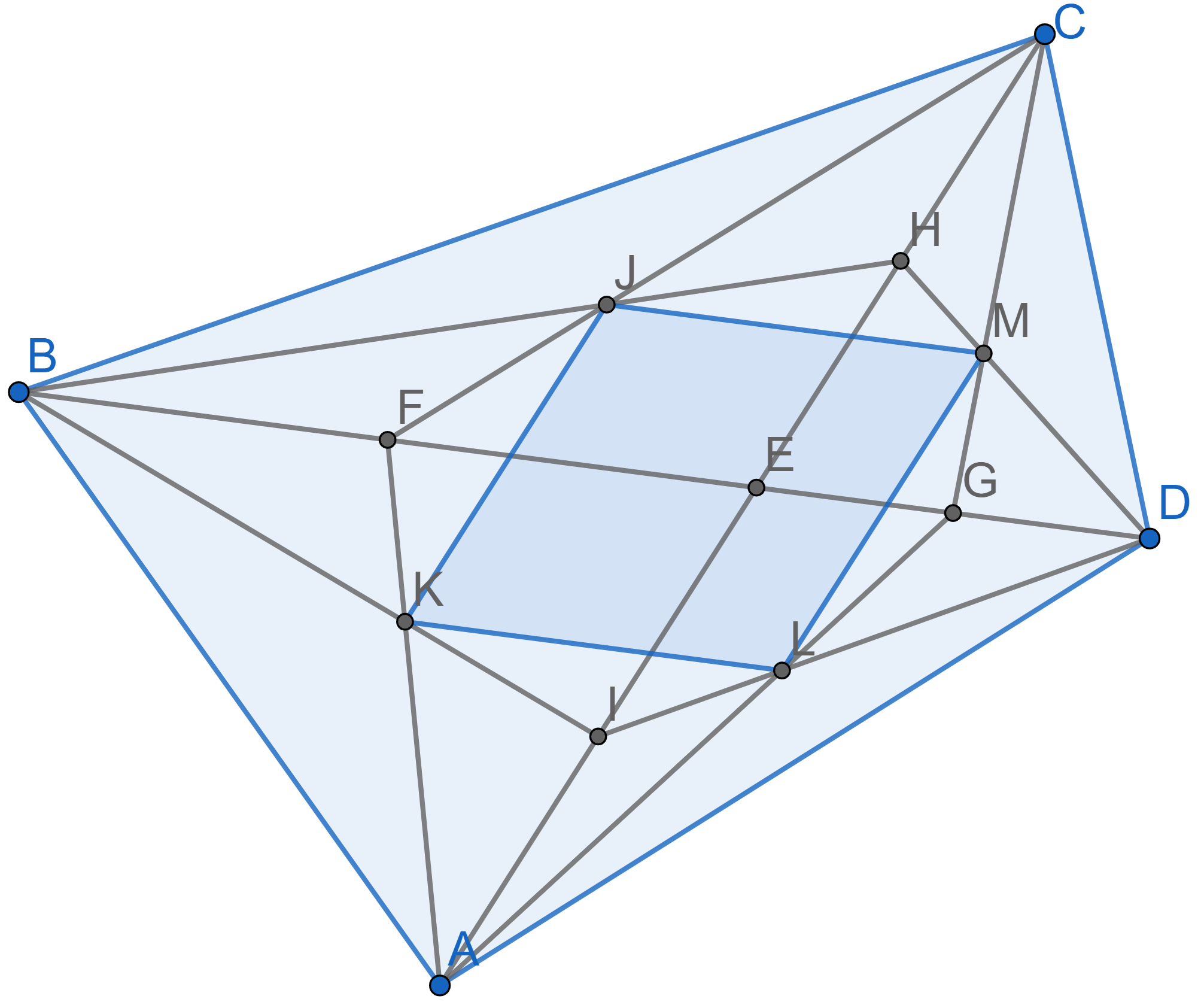
Prove that the quadrilateral \(KJML\) is a parallelogram.
You may wish to use the fact that the point of intersection of the medians of any triangle divides each median in the ratio \(2:1\), counting from the vertex, but if you use this fact, you should prove it.
For a trapezium \(ABCD\), let \(E\) be the point of intersection of the sides \(AB\) and \(CD\), and let the point \(G\) be the point of intersection of the diagonals of the trapezium. Finally, let \(F\) amd \(H\) be the midpoints of the sides \(BC\) and \(AD\) respectively.
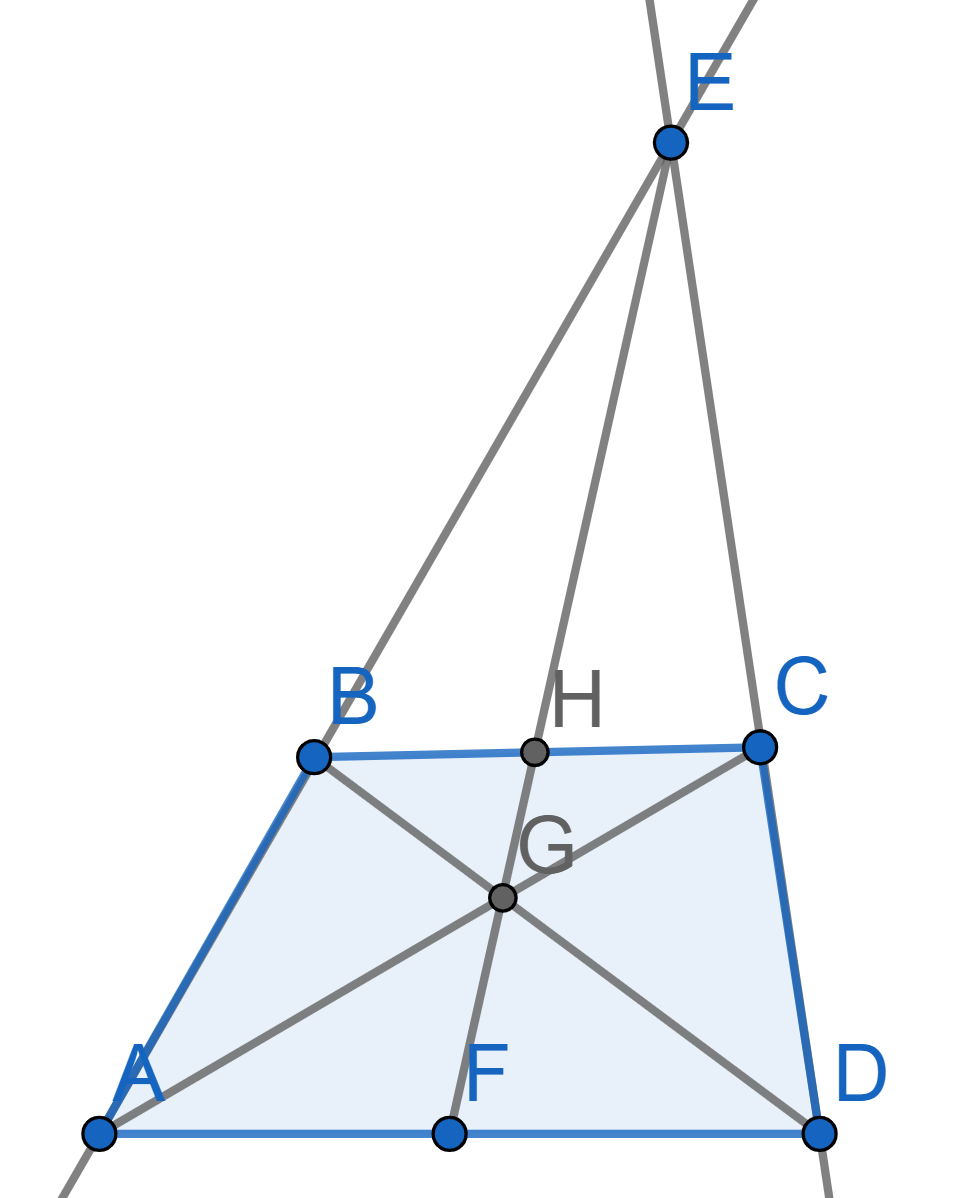
Prove that the points \(E,F,G,H\) lie on one line.
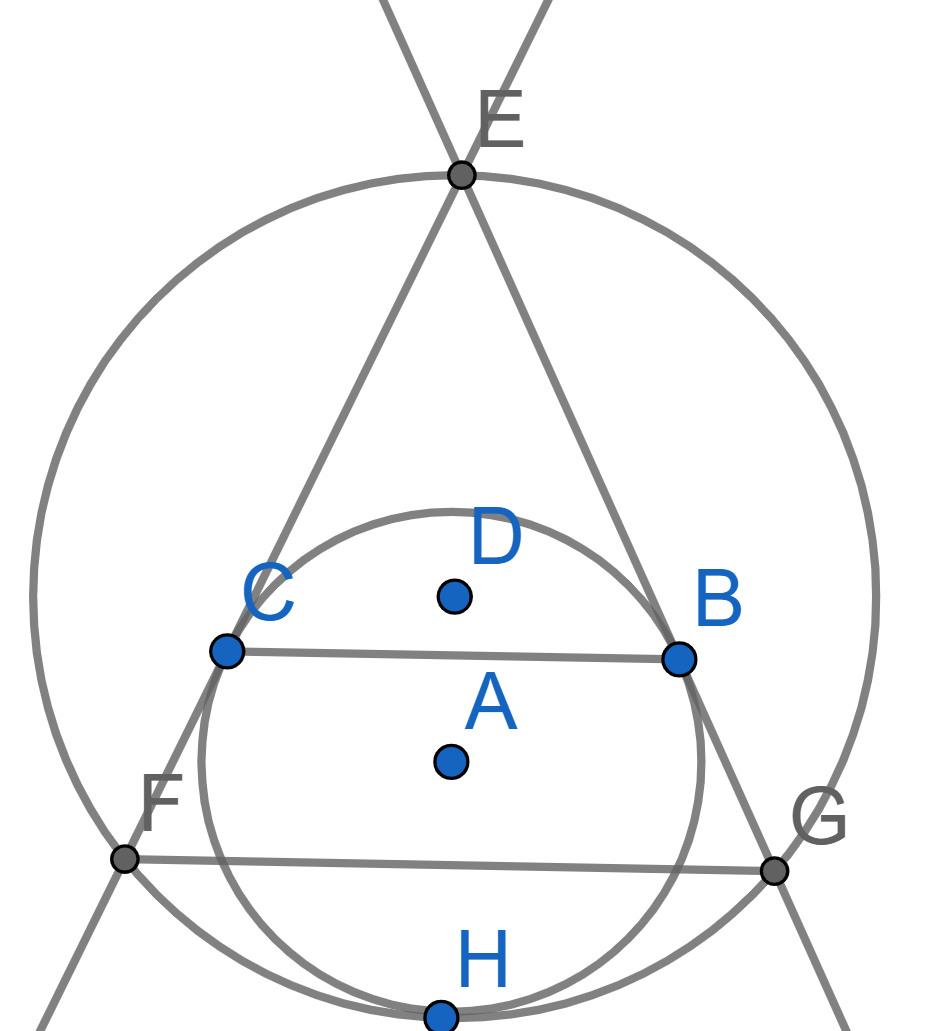
The triangle \(EFG\) is isosceles with \(EF=EG\). A circle with center \(A\) is tangent to the sides \(EF\) and \(EG\) at the points \(C\) and \(B\) respectively. It is also tangent to the circle circumscribed around the triangle \(EFG\) at the point \(H\). Prove that the midpoint of the segment \(BC\) is the center of the circle inscribed into the triangle \(EFG\).
Prove that under a homothety transformation, a polygon is transformed into a similar polygon.
Hint: to show this, why is it enough for you to show that homothety preserves angles and ratios?
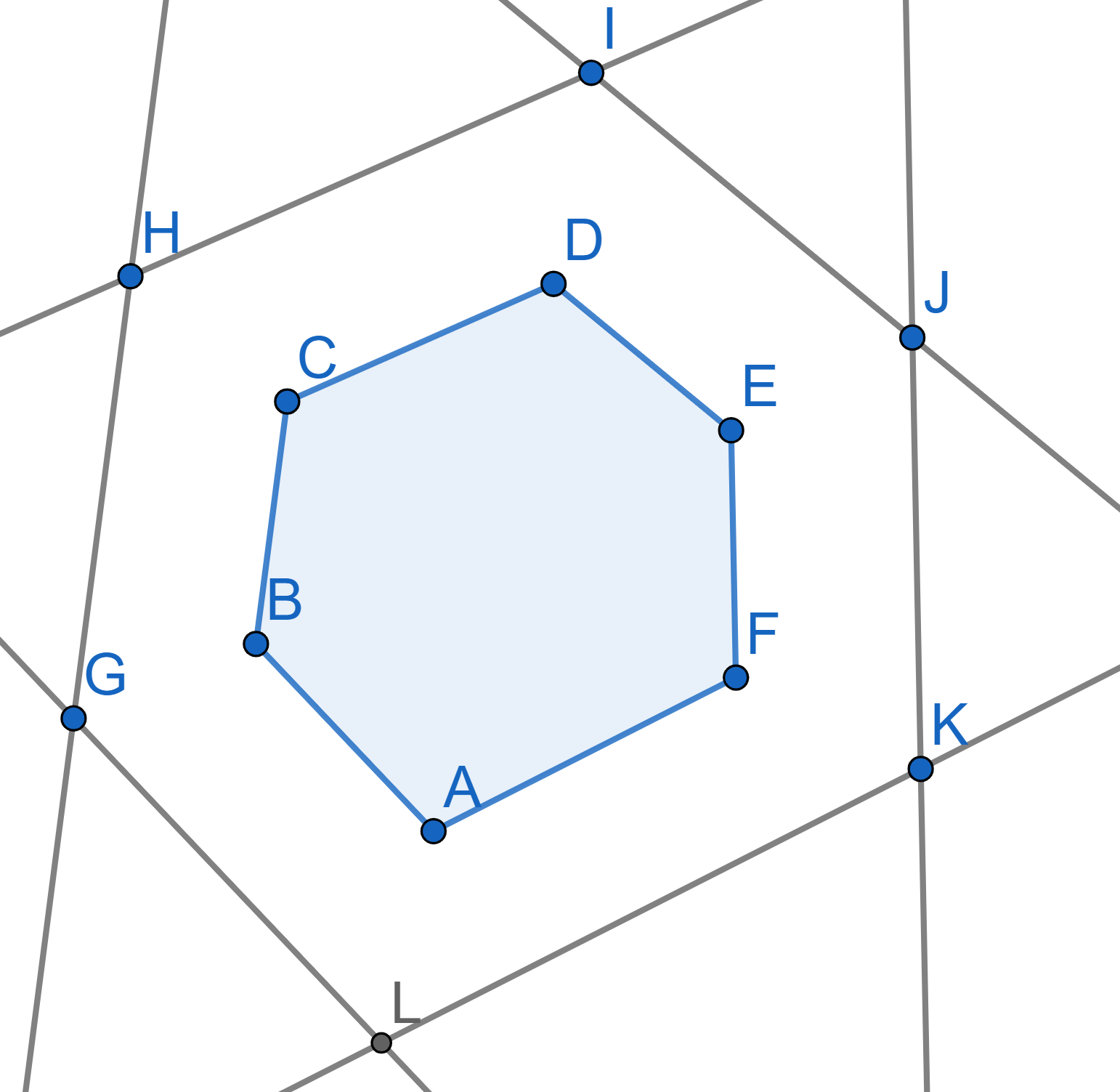
A convex polygon \(A_1A_2...A_n\) has the following property: if we parallel push all the lines containing the sides of the polygon for a distance \(1\) outside, we will obtain another polygon, similar to the original one with the corresponding parallel sides of the same ratio. Prove that one can inscribe a circle into the original polygon \(A_1A_2...A_n\).
For a triangle \(ABC\) denote by \(R\) the radius of the circle superscribed around \(ABC\), by \(r\) the radius of circle inscribed into \(ABC\). Prove that \(R\geq 2r\) and equality holds if and only if the triangle \(ABC\) is regular. For this problem, you may want to search about the “Euler Circle” online.
Under a homothety transformation, a line \(l\) is sent to a line \(l'\) which is parallel to \(l\).
Show that a homothety is uniquely determined by where it sends any two distinct points.